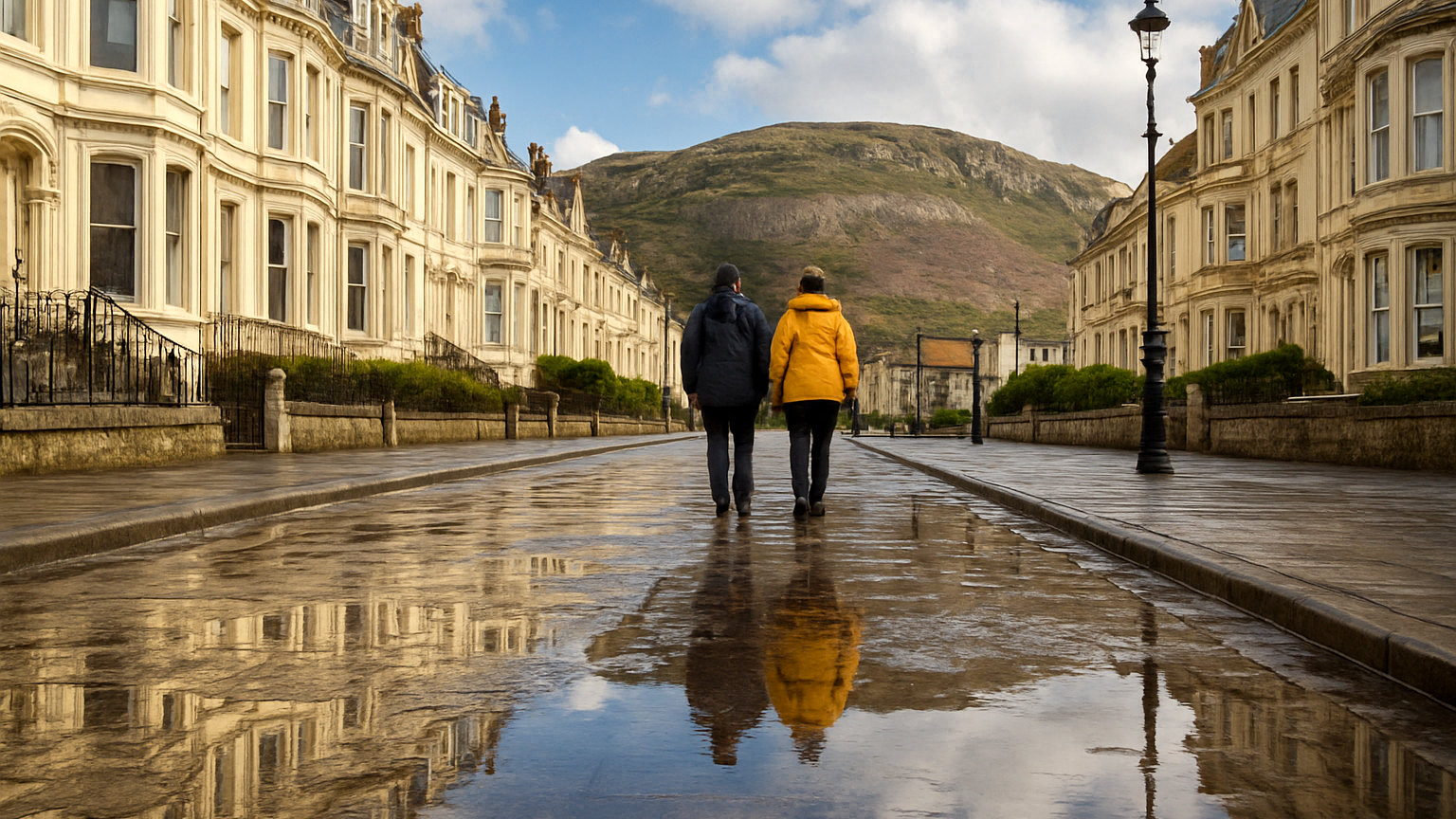
Llandudno was laid out in the mid nineteenth century as a planned seaside resort and has survived remarkably intact, with a curving promenade of stuccoed hotels between two limestone headlands. It is generally regarded as the most complete Victorian resort in Britain.
What is the Great Orme?
A limestone headland rising above the town, with a summit reached by three means: a Victorian cable hauled tramway, a cable car, and a toll road running round the seaward side.
The headland holds a Bronze Age copper mine open to visitors, a herd of feral goats, rare plants and butterflies, and views across to Anglesey and Eryri.
What is the tramway?
One of very few cable hauled street tramways still operating anywhere, running from the town to the summit in two sections since 1902.
It is a working transport system rather than a heritage attraction and remains the most enjoyable way up.
What is on the seafront?
A two mile promenade of Victorian hotels curving round the bay, and a pier extending from beneath the Orme, which is among the longest in Wales and retains its ironwork.
The beach is shingle on the north shore and sand on the west, which is quieter and faces Anglesey.
What about the architecture?
Consistent and protected. The town was built to a single plan with height and materials controlled, and the wide streets and covered walkways of Mostyn Street remain much as designed.
It gives the town a coherence that resorts developed piecemeal do not have.
What is nearby on the coast?
Conwy, a walled medieval town with one of the finest castles in Britain, ten minutes away by train, with complete town walls you can walk.
Anglesey across the strait, and the smaller resorts of Colwyn Bay and Rhos on Sea along the coast.
How close is Eryri?
Very. The Conwy Valley railway runs inland from Llandudno Junction to Betws y Coed and Blaenau Ffestiniog, giving access to the mountains without a car.
Betws y Coed is around forty minutes and is the main walking base for the eastern part of the national park.
Who does it suit?
Families, older visitors and anyone wanting a traditional seaside holiday with a promenade, a pier and donkeys on the sand, all of which are still there.
Also walkers, given the Orme and the proximity of the mountains, and anyone interested in Victorian architecture.
How do you get there?
By train from Chester and Crewe on the north Wales coast line, with through services from Manchester and London.
The town is easily reached by road from the north west of England, which is where most of its visitors come from.
Where should you eat?
The town has a good range for its size, with several long established hotels serving dinner and independent restaurants in the centre.
Conwy nearby has a strong food reputation, including mussels from the estuary.
How long do you need?
Two or three nights, which covers the town, the Orme, Conwy and a day in the mountains.
It is busiest in summer and pleasant in spring and autumn, when the seafront is quiet and the mountains are at their best.
What about the Alice connection?
The family of the girl for whom the Alice stories were written holidayed in Llandudno, and the town commemorates the association with a trail of sculptures and a plaque. The connection is holiday visits rather than the writing itself, and the town is honest that Oxford has the stronger claim, but the trail is a pleasant way to walk the seafront with children.
One last practicality: the Great Orme tramway and cable car both operate seasonally and close in winter and in high wind, so check before relying on either. The road to the summit is open year round.
A final note on the season: the town trades year round, unlike many resorts, with hotels, restaurants and the pier open through the winter. That makes it one of the more reliable off season seaside destinations in Britain.