York holds more visible history per acre than anywhere else in England. It was a Roman legionary fortress, a Viking capital, a medieval wool city and the hub of the Victorian railway network, and all four are still legible within a circuit of walls you can walk in two hours.
What is the Minster?
The largest Gothic cathedral in northern Europe, holding around half of all the medieval stained glass in England, including a window the size of a tennis court at the east end.
The tower can be climbed, the undercroft holds Roman and Norman remains beneath the building, and admission is charged with the tower ticketed separately.
Can you walk the walls?
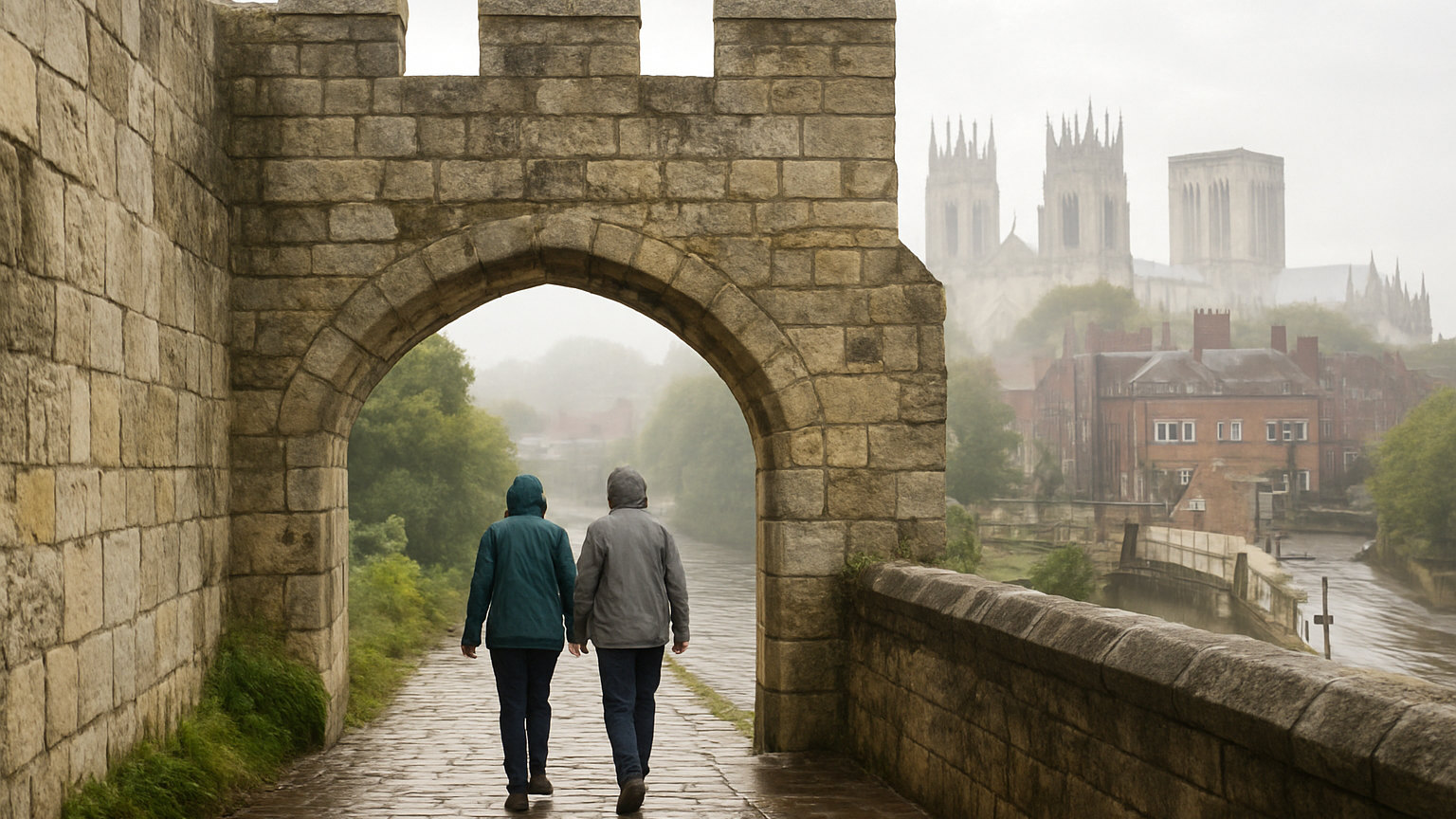
Yes, and it is the best introduction to the city. The circuit is around two miles, largely complete, free, and passes four medieval gatehouses known as bars.
The section approaching the Minster gives the classic view. The walls close at dusk and are slippery in wet weather.
What is the Shambles?
A narrow medieval street of overhanging timber buildings, once occupied by butchers, with the upper floors nearly meeting overhead.
It is extremely busy from mid morning. Go at eight and it is a different place entirely, which applies to the surrounding snickelways as well.
What about the Viking history?
York was a Norse city and excavations beneath a shopping centre uncovered preserved timber buildings and an enormous quantity of everyday objects.
A visitor attraction built on the site reconstructs the settlement, and the finds themselves are the substantial part of it.
What is the railway museum?
The national collection, free, holding record breaking locomotives including one that holds the world speed record for steam, along with royal carriages and an enormous hall of rolling stock.
It is among the best free museums in Britain and needs half a day.
What else is worth seeing?
The Castle Museum, with recreated Victorian streets. Clifford's Tower on its mound, the surviving keep of the castle. The Yorkshire Museum in its gardens beside the abbey ruins.
The Bar Convent, the oldest surviving convent in England, and the medieval guildhalls.
How busy does it get?
Very. York is among the most visited cities in England outside London and the central streets are congested from mid morning through the afternoon in season.
Early morning transforms it, and winter weekdays are quiet. The Christmas market period is the busiest of all.
How do you get there?
By train, with London under two hours and Edinburgh around two and a half on the east coast main line. The station is a short walk from the walls.
A car is a liability in the centre, where parking is limited and expensive and the streets are largely pedestrianised.
What day trips work?
The North York Moors and the coast at Whitby and Scarborough, the Yorkshire Dales to the west, and Castle Howard half an hour away.
Leeds is twenty minutes and Durham under an hour by train.
How long do you need?
Two or three nights. The city itself fills two days comfortably and rewards a third with a day trip.
It is compact enough to cover entirely on foot, which is unusual for a place with this much in it.
What about flooding?
York sits at the confluence of two rivers and floods, sometimes seriously, most often in winter and early spring. Riverside paths and some streets close, and occasionally attractions do. It is well managed and well signposted, and checking flood warnings before a winter visit is sensible rather than alarmist.
What about the Christmas period?
York runs a substantial festive market through late November and December, which fills the city entirely at weekends and raises accommodation prices sharply. It is well done and it is the busiest the city gets all year. Midweek visits during the market are markedly easier than Saturdays, when the central streets become difficult to move through at all.