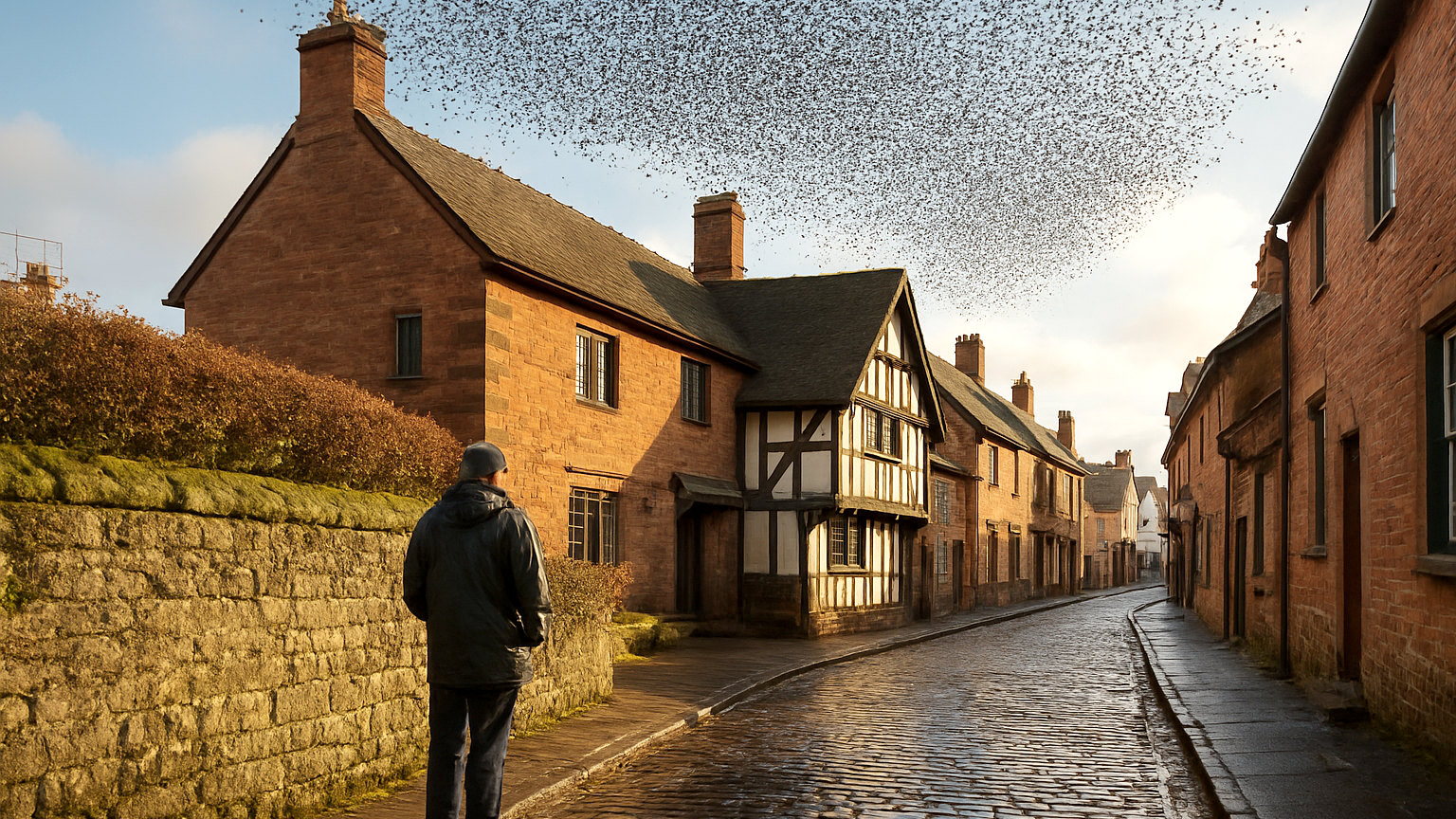
A murmuration is a mass aerial display by starlings gathering to roost, in which tens or occasionally hundreds of thousands of birds move as a single shifting shape before dropping into cover. It is free to watch, happens on a predictable schedule and is among the most impressive wildlife spectacles available in Britain.
Why do they do it?
Probably several reasons at once. Safety in numbers against predators such as peregrines and sparrowhawks, which find it difficult to target an individual in a shifting mass. Warmth, since a communal roost conserves heat on winter nights.
Possibly also information sharing about feeding sites. The coordinated movement itself comes from each bird responding to the handful nearest it rather than to the flock as a whole.
When does it happen?
From roughly October to February, peaking in December and January when numbers are swollen by birds arriving from continental Europe.
The display occurs at dusk, in the twenty to forty minutes before dark. Timing therefore shifts substantially through the season, from around half past four in midwinter to later in autumn and early spring.
Where are the best places to watch?
The Somerset Levels, particularly around Ham Wall and Shapwick Heath, where reedbed roosts hold very large numbers and the reserves publish where the birds are roosting each week.
Brighton's piers and Aberystwyth pier, where birds roost on the structures above the sea. Leighton Moss in Lancashire, Otmoor in Oxfordshire, Gretna in Dumfriesshire and Blackpool are all reliable.
Why do the sites move?
Because the birds choose the roost, not the reserve. Starlings shift between reedbeds and structures within an area from week to week, and a site that held a hundred thousand birds last month may be empty now.
This is why checking a recent report matters. Several reserves run a telephone line or social media update saying where the birds went the previous evening.
What time should you arrive?
At least half an hour before sunset, and preferably an hour. Birds arrive in streams from all directions, building up gradually, and much of the interest is in the gathering.
The display itself is short. Once the birds drop into the reeds it is over in seconds, and people arriving at sunset frequently miss it entirely.
What conditions are best?
Still, clear evenings, when birds gather high and swirl for longer. Wind pushes them low and shortens the display, and heavy rain suppresses it.
The presence of a predator transforms it. A peregrine over the roost produces the tightest and most dramatic shapes, so a hunting raptor is good news for spectators.
What should you take?
Warm clothing, considerably more than a walk requires, since you will be standing still at the coldest part of a winter day. A torch for the walk back, since it will be dark when you leave.
Binoculars are useful but not essential; this is a spectacle seen with the naked eye. Wellingtons at reedbed sites, which are wet by definition.
How do you photograph it?
With difficulty, since light is failing at exactly the moment the display peaks. A wide lens capturing the shape against the sky works better than a long lens.
Video frequently conveys it better than stills, because the movement is the point and a photograph of a dark cloud rarely does it justice.
Are starlings doing well?
No, which is the melancholy footnote. Despite the scale of the winter roosts, the British breeding population has declined sharply over recent decades and the species is of serious conservation concern.
The murmurations remain spectacular partly because winter numbers are boosted by migrants. Seeing one is a good argument for caring what happens to a bird most people think of as common.
A final practical point: check the sunset time for your date rather than assuming. Between October and February it moves by more than two hours, and turning up at half past four in October means a long cold wait, while the same arrival in December means you have missed it.