Cathedrals were centres of learning long before universities existed, and several still hold libraries of national importance. One of them contains something that survives nowhere else in the world at anything like the same scale.
What is at Hereford?
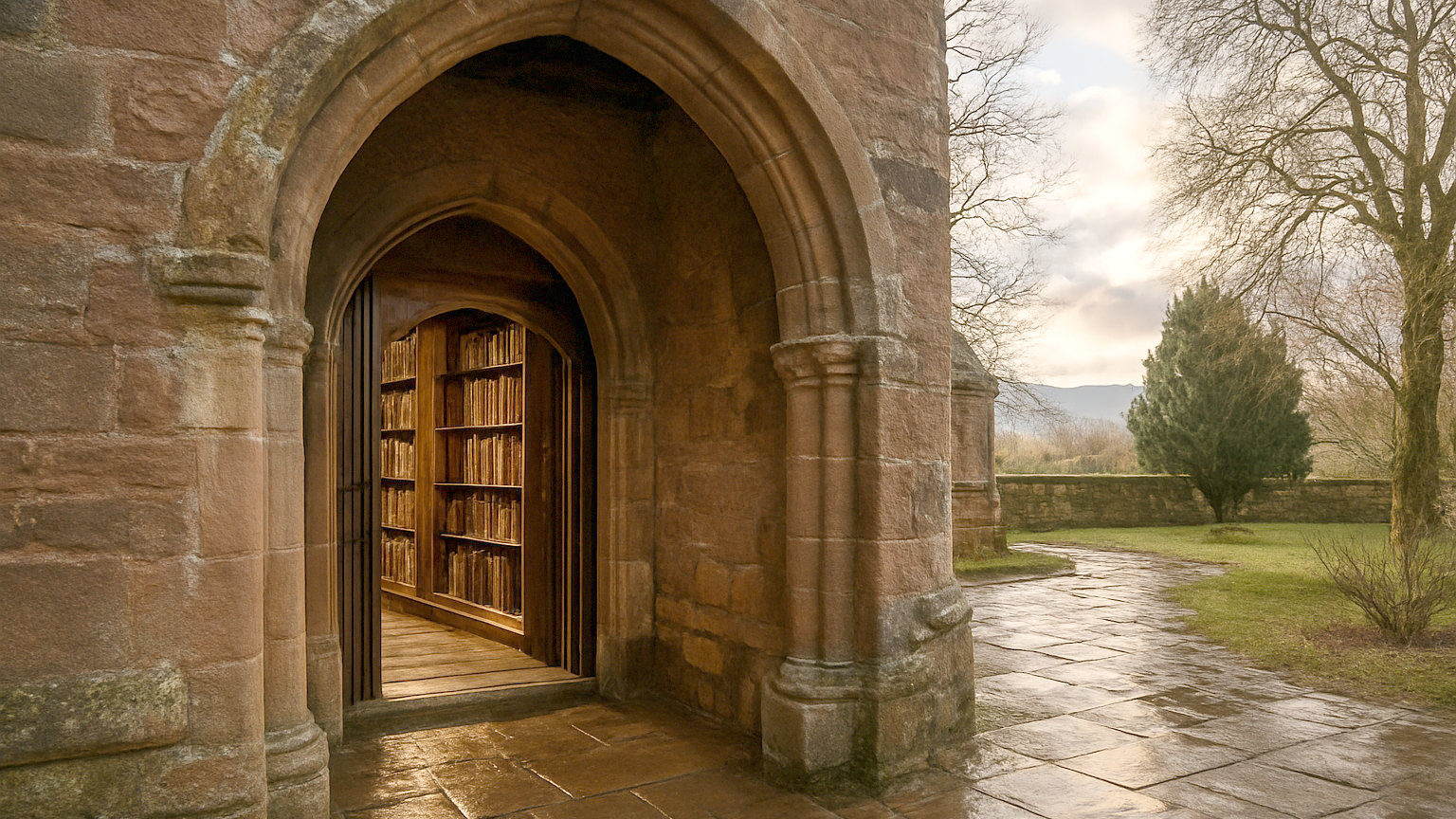
The largest chained library in the world with its chains, rods and locks all intact, holding around fifteen hundred books, several of them medieval manuscripts.
Books were chained by the front cover to a rod running along the shelf, so they could be read at the desk but not removed. Nowhere else preserves the whole system complete.
What else is in that room?
The Mappa Mundi, the largest surviving medieval world map, drawn on a single sheet of calfskin around 1300, showing the world as understood at the time with Jerusalem at the centre.
It is displayed alongside interpretation explaining what the map is actually doing, which is theology and history rather than navigation.
Is there another chained library?
Wells has one, above the eastern cloister, holding books chained in the same way in a long room with the original fittings.
It opens on limited days and is smaller than Hereford's, and the room itself is beautiful.
What is at Durham?
A substantial collection connected to the monastic community and to the earlier foundation at Lindisfarne, with treasures displayed in a permanent exhibition in the monastic buildings.
The relics of the community's saint and the surviving fragments of his coffin are shown, along with manuscripts and metalwork.
What about York?
York Minster Library is the largest cathedral library in England, holding well over a hundred thousand volumes, housed in a former chapel in the precinct.
It functions as a working research library and access arrangements differ from those for a display collection.
What is at Salisbury?
A library above the cloister holding early printed books and manuscripts, and separately, in the chapter house, one of only four surviving original copies of Magna Carta.
Salisbury's is generally considered the best preserved of the four.
What is at Lincoln?
A library designed by Christopher Wren in the seventeenth century, built above part of the cloister, holding medieval manuscripts and early printed books.
Lincoln also holds one of the four Magna Carta originals, displayed in the castle across the square rather than in the cathedral.
How do you get in?
It varies considerably. Some libraries are included in general admission, some open on set days or by guided tour, and some require an appointment for research access.
Check the specific cathedral, since opening for these rooms is frequently much narrower than for the church itself.
Why did cathedrals have libraries?
Because they were the principal centres of literacy, scholarship and record keeping in their regions for centuries, producing manuscripts as well as collecting them.
Monastic cathedrals had scriptoria, and the libraries continued after the dissolution under deans and chapters.
What survives beyond books?
Archives, which at several cathedrals run back a thousand years and are among the most complete local record collections in the country.
Many are open to researchers and hold material on land, families and building work that exists nowhere else.
What should you know before visiting?
Rooms are small, light levels are kept low for conservation, and bags and photography are usually restricted.
Numbers are limited, so book where booking is offered. These are among the most rewarding parts of any cathedral and the least visited.
What is the best one to see first?
Hereford, without much doubt, since the chained library and the Mappa Mundi are in the same room and there is nothing comparable anywhere. It is ticketed separately from the cathedral, takes around an hour and is among the most remarkable things in any English building.
One final note: several cathedral libraries and archives run open days and talks through the year, which give access to material not normally displayed.
A final thought: these rooms hold the working knowledge of institutions that have existed for a thousand years, and seeing the books in the room they were written for is quite different from seeing them behind glass in a museum.