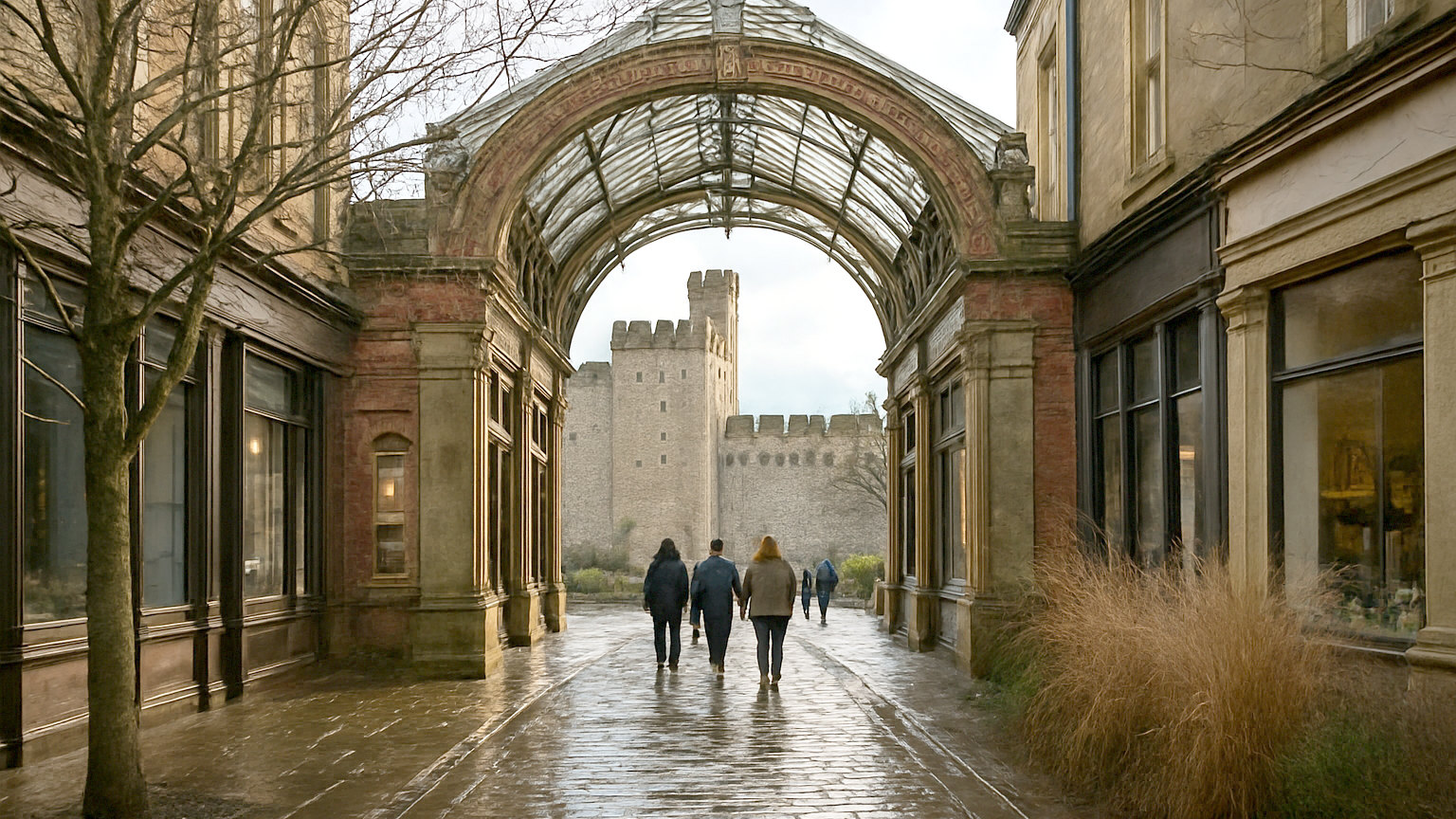
The shopping arcade is a nineteenth century invention: a covered pedestrian passage lined with small shops under a glazed roof, built to let people shop in comfort away from mud and traffic. Britain has a substantial number of survivors and several are architecturally outstanding.
Where are the best arcades?
Cardiff, which describes itself as the city of arcades and has more surviving Victorian and Edwardian examples than anywhere else in Britain, forming a network of passages between the main streets.
Leeds, where the County Arcade and the Victoria Quarter are the most elaborate in the country, with mosaic floors, marble and a stained glass roof over a former street.
What about London?
Burlington Arcade off Piccadilly, opened in 1819 and the earliest of the great arcades, patrolled by uniformed beadles who historically enforced rules against running, whistling and singing.
The Royal Arcade, Princes Arcade and the Piccadilly Arcade nearby form a cluster of high end retail. Cecil Court, though not glazed, works on the same principle for booksellers.
Which others are worth seeing?
The Argyll Arcade in Glasgow, occupied almost entirely by jewellers, which has traded since the eighteen twenties. Barton Arcade in Manchester, with elaborate cast ironwork.
The Royal Arcade in Norwich, with art nouveau tilework. The Wayfarers in Southport, the Grand Arcade in Leeds and the Great Western Arcade in Birmingham.
Why were they built?
To create a controlled retail environment before the department store existed. They offered shelter, gas lighting, security and an absence of horses, which made shopping pleasant for the middle classes in a way the street was not.
They were also speculative property developments, and several were built over slum courts that were cleared to make way for them.
What is in them now?
Overwhelmingly independents, which is much of the appeal. Small units suit jewellers, tailors, barbers, record shops, coffee houses and specialist retailers rather than chains needing large floorplates.
Cardiff's arcades in particular hold the majority of the city's independent shops, including long established businesses that have traded in the same unit for generations.
Are they still commercially viable?
Mostly, and they have fared better than conventional high streets, precisely because the units are small and cheap enough for independents and because the buildings are attractive.
Several have been restored in recent decades after periods of decline, and they now function as a distinct retail category rather than a survival.
What should you look at architecturally?
The roof structure, which is the point of the building: iron and glass engineering displayed rather than hidden. Mosaic and tile floors, decorative ironwork balconies and original shopfronts.
Clock mechanisms, ventilation grilles and the original signage that survives above later fascias, which frequently shows what a unit was a century ago.
When should you visit?
Weekday mornings, when they are quiet and you can look at the building rather than the crowd. Several are closed or partly shut on Sundays.
They also make excellent wet weather options, being covered by design, which is exactly why they were built in a country with this climate.
How do they compare to modern centres?
Better, on almost every measure that matters to a visitor: architecture, independent retail, human scale and the fact that you can walk through them as a route rather than being funnelled round a circuit.
They are also short. An arcade takes two minutes to walk and rewards ten.
Where should you start?
Cardiff, for the number and concentration, where a walk linking six or seven arcades takes an hour and covers most of the city centre.
Otherwise Leeds for sheer decorative extravagance, which is the most impressive single arcade interior in Britain.
One final practical note: several arcades are through routes as well as destinations, connecting parallel streets, which makes them useful shortcuts in the rain as well as places to shop. In Cardiff and Leeds in particular, learning which arcade emerges where is the quickest way to cross the city centre on a wet afternoon.