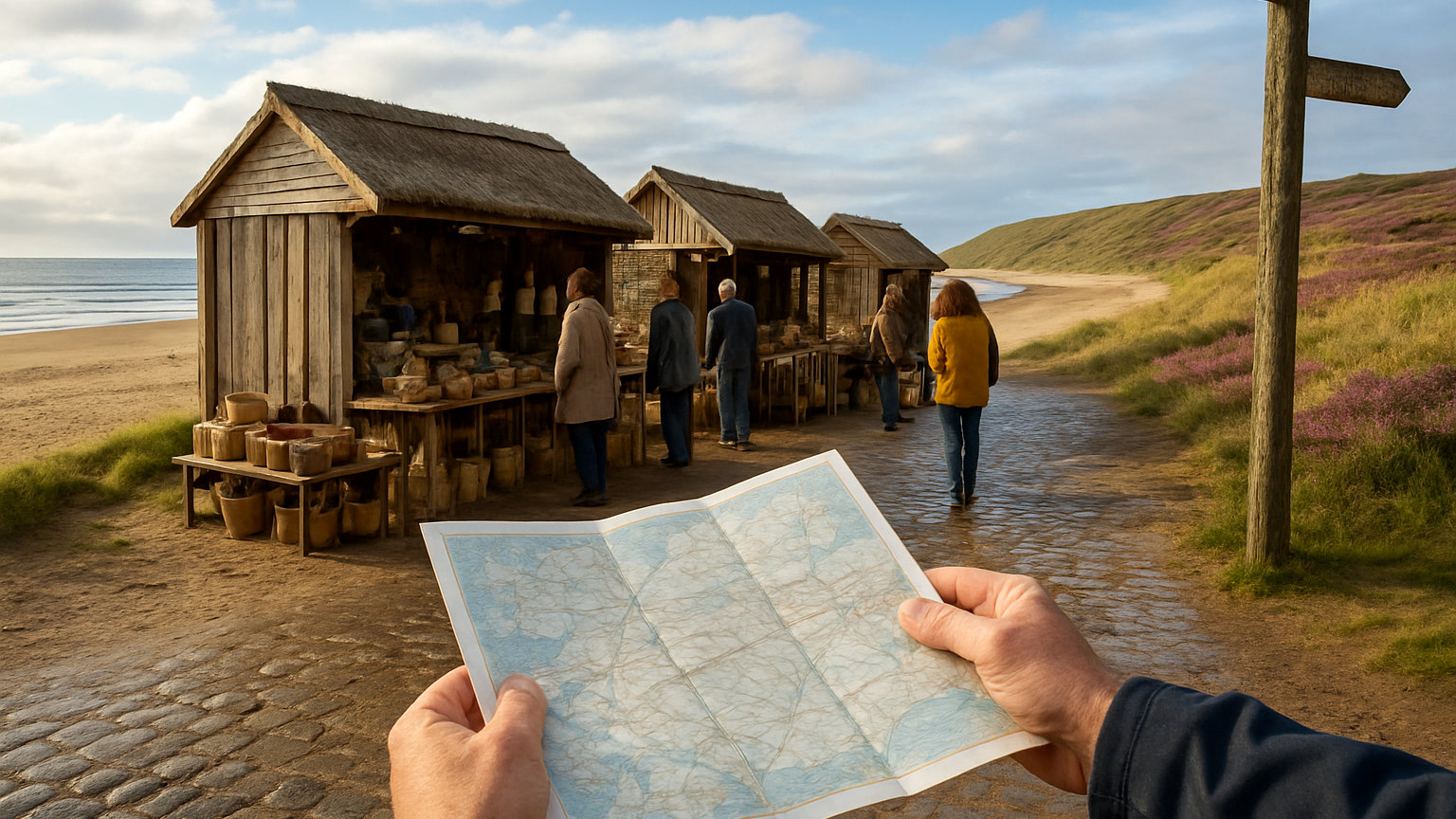
Craft in Britain has had a strong revival, supported by a network of galleries, fairs and open studio schemes that let buyers deal directly with makers. It is also the most satisfying kind of shopping to do on a trip, since what you buy is made where you bought it.
What is Britain particularly good at?
Studio ceramics, which has a long and distinguished tradition and remains the largest craft sector. Textiles, including handweaving, knitwear and quilting.
Also glass, with a heritage centred on the west midlands, silversmithing, furniture making, bookbinding and green woodworking. Basketry and willow work survive in the Somerset Levels where the willow is grown.
Where do you buy directly from makers?
Open studio events, held regionally through the year, where makers open their workshops to the public for a weekend or a fortnight. These are free, well signposted and the best way to see work being made.
Almost every county runs one, usually in spring or early summer, with a printed trail map. Local arts organisations publish the dates.
What are the major craft fairs?
Several substantial selling fairs run annually, bringing together a few hundred makers under one roof, with regional events in the south west, the north and Scotland.
They charge admission, and the standard is high because makers are selected. For anyone wanting to see the breadth of what is made in Britain in one afternoon, they are the efficient option.
Which galleries sell craft?
Dedicated craft galleries exist in most sizeable towns and many rural areas, selling ceramics, jewellery and textiles on commission from makers.
Several museums and heritage properties also have serious craft shops, and national craft organisations run galleries in London and elsewhere with selected work.
What about the pottery towns?
Stoke on Trent remains the centre of British ceramics, with factory shops, museums and working potteries that can be toured. It is the place to buy tableware at source.
Studio potters are spread across the country, with clusters in Cornwall, Wales and Yorkshire. Many sell from the workshop and welcome visitors if contacted first.
Where do you buy textiles?
Welsh woollen mills, several of which still operate and sell blankets and cloth from the mill shop. Border mills in Scotland for knitwear and cashmere.
The Outer Hebrides for Harris Tweed, where the cloth is woven in homes and sold locally, and Shetland for knitwear. In all three cases the mill shop price is considerably below retail elsewhere.
How do you know it is genuinely handmade?
Ask, and ask who made it. A gallery selling craft will name the maker and frequently have information about them. Anything sold anonymously is likely to be imported.
Protected marks apply to a few products, notably Harris Tweed. Membership of craft guilds and maker associations is a reasonable indicator of standard.
What does it cost?
More than mass produced equivalents, since the maker's time is the main cost. A handmade mug costs several times a factory one and will outlast it.
Buying directly from a maker at an open studio or a fair is usually cheaper than through a gallery, which takes a commission, though the gallery provides the selection service.
What should you buy on a trip?
Something small and robust, since craft objects travel badly. Jewellery, small ceramics, textiles and prints all pack well.
Makers will frequently pack and post larger pieces, which is worth asking about rather than attempting to carry a bowl home in a rucksack.
Why buy it at all?
Because it supports skills that are genuinely at risk, several of which are on formal lists of endangered crafts in Britain, and because the object is better than the alternative.
It also gives a trip something to show for it beyond photographs, made by someone whose workshop you stood in.
One last suggestion: ask makers about commissions. A great many will make something to order, frequently for little more than the price of comparable stock, and the wait is usually weeks rather than months. For anything you cannot carry home, this solves the transport problem and produces something made specifically for you.