Highland games take place across Scotland most weekends between May and September, at a scale ranging from a village field with a few hundred spectators to major gatherings drawing thousands. They combine athletics, piping and dancing in a format that has changed remarkably little in a century and a half.
What are the heavy events?
The distinctive part. Competitors throw weights for distance and height, put the stone, which is a shot put with an older name, and throw the hammer, spinning it around the head before release.
The heavyweights are large men in kilts and the events are genuinely impressive at close range. Most games run a full programme through the afternoon.
How does the caber toss work?
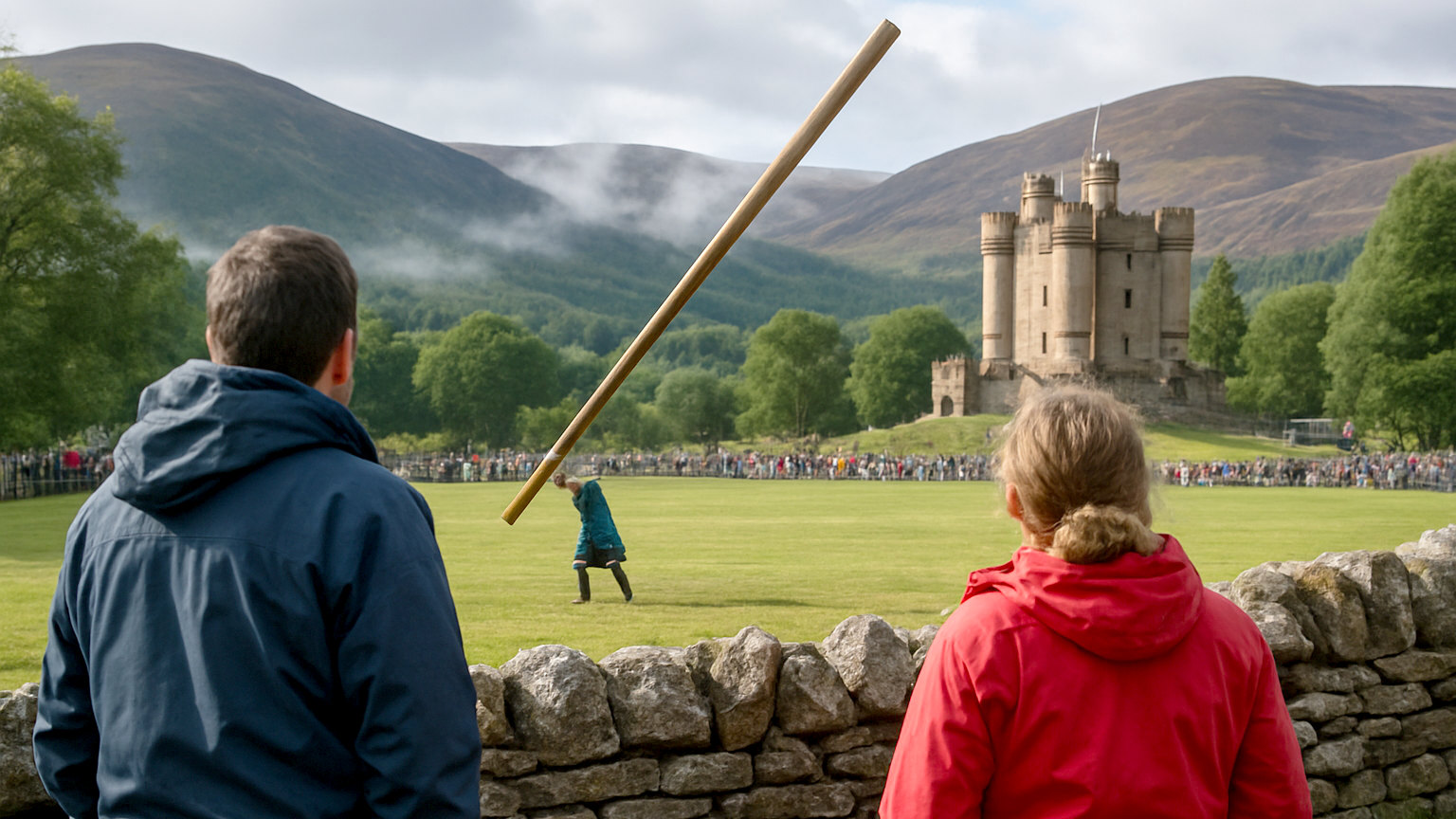
The caber is a tapered tree trunk, several metres long and heavy, which the competitor lifts vertically, balances against the shoulder, runs with and then flips end over end.
It is not judged on distance. The aim is to have the caber land pointing directly away from the thrower, scored as a perfect twelve o'clock, with anything off that measured by clock position. This surprises most first time spectators.
What else happens?
Highland dancing, competed by dancers of all ages, with the sword dance and the Highland fling the best known. Solo piping competitions, and massed pipe bands marching, which is usually the closing spectacle.
Track and field events, tug of war, and a hill race, where competitors run up and down the nearest hill, which at some gatherings is a serious ascent.
Which are the major gatherings?
The Braemar Gathering in Aberdeenshire in early September, the most famous and historically attended by members of the royal family, which makes it the most crowded and the hardest to get tickets for.
The Cowal Highland Gathering at Dunoon in August is the largest by participation, with an enormous massed pipe band march. Oban, Inverness, Ballater, Aboyne and Lonach are all substantial.
Are the small ones worth it?
Frequently more enjoyable than the famous ones. A village games has the same events, a fraction of the crowd, cheaper entry and a considerably more relaxed atmosphere, with local families rather than coach parties.
Almost every Highland community holds one, and the local tourist information or council website lists dates for the region.
When does the season run?
From May to mid September, with the greatest concentration in July and August. Braemar in early September traditionally closes the season.
Dates are fixed year to year and published well in advance, which makes it easy to build a Highland trip around one.
What should you take?
Waterproofs and warm layers regardless of the month, since games are held in open fields and the weather does not stop them. Something to sit on, since seating is limited and usually costs extra.
Cash, since smaller games may have limited card facilities, and sun cream, which people forget in Scotland and regret.
How long do they last?
Most of a day, typically from late morning to late afternoon, with events running simultaneously in different parts of the field. There is no need to stay for all of it.
Arrive for the opening march, watch the heavies for an hour and stay for the massed bands at the end if you want the highlights in three hours.
Can visitors take part?
In some events, yes. Several games run open tug of war teams, novice heavy events, hill races and children's races that anybody can enter on the day.
Ask at the secretary's tent. Small games in particular are frequently short of entrants and welcome anyone willing to have a go.
What should you know about the history?
The modern format dates largely from the nineteenth century, when Highland culture was revived and romanticised after decades of suppression following the Jacobite risings. Some events have older roots in tests of strength used to select men for service. The Victorian enthusiasm for all things Highland, and royal patronage at Braemar in particular, shaped the games into the form they take today.