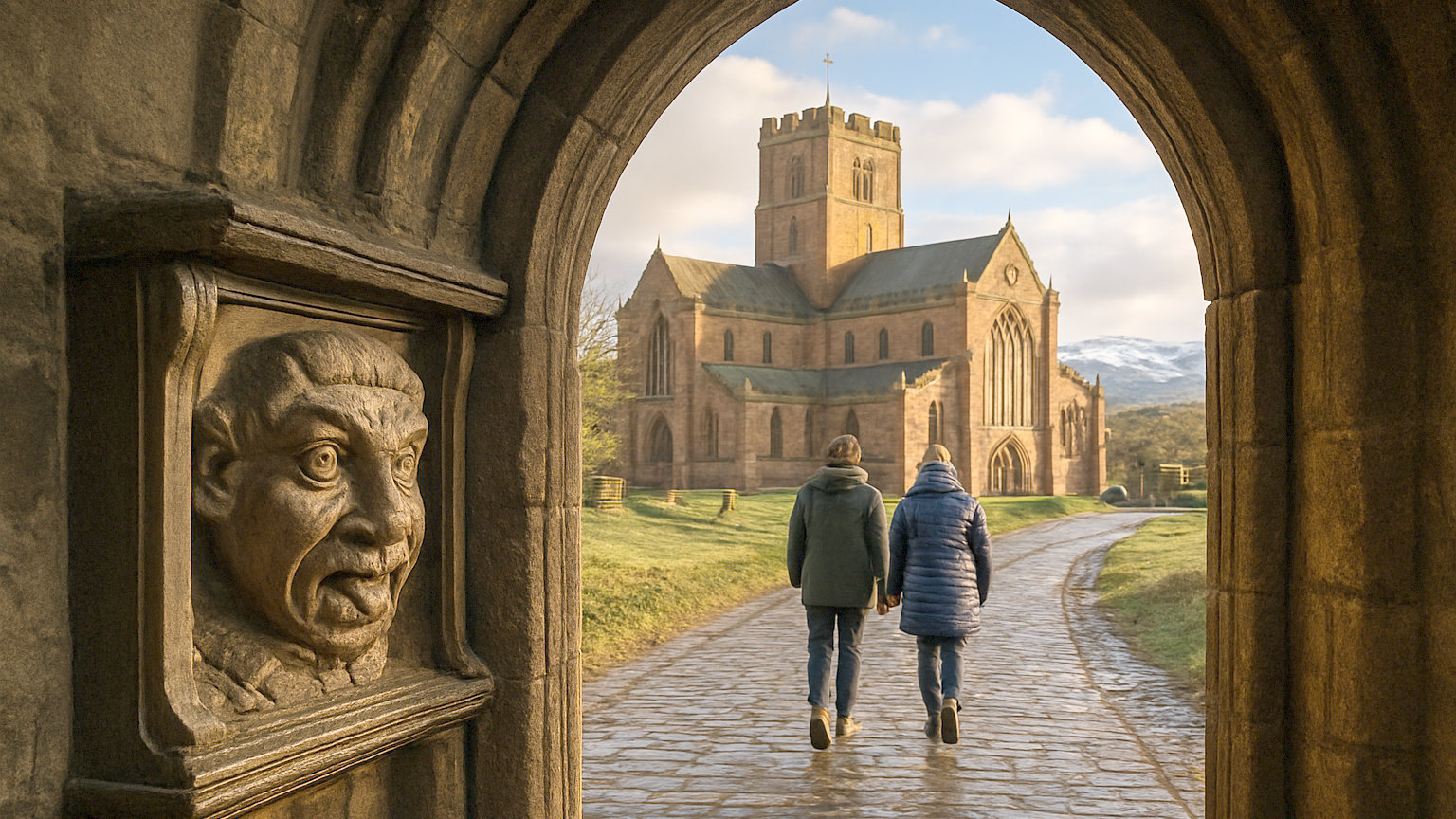
A misericord is a small ledge on the underside of a hinged choir seat, which supported a standing member of the community during long services. The undersides were carved, and because they were hidden when the seat was down the carvers took liberties they never took elsewhere.
Why were they made?
Because services required standing for extended periods and older or infirm clergy could not manage it. The seat tipped up and the ledge took some of the weight.
The name comes from the Latin for mercy, which describes exactly what the arrangement was for.
What is carved on them?
Very little that is religious. Foliage, animals, mythical beasts, proverbs, scenes of daily work, domestic arguments, drinking, and a great deal of straightforward comedy.
Because they faced the floor and were hidden most of the time, they escaped the attention that destroyed imagery elsewhere in these buildings.
Where are the best sets?
Ripon Cathedral, whose carvings include a griffin, a rabbit disappearing into a hole and a number of scenes that have been linked, plausibly or not, to a later writer whose father was a canon there.
Beverley Minster in Yorkshire has one of the largest sets in the country, and Chester and Lincoln both hold outstanding work.
What is at Exeter?
The earliest complete set in England, dating from the thirteenth century, including a carving of an elephant made by someone who had clearly never seen one.
An elephant was presented to Henry the Third in 1255 and drew crowds in London, which may be the connection.
Where else should you look?
Wells, Carlisle, Worcester, Gloucester, Norwich, Ely, Winchester and Manchester all retain significant sets.
A number of parish churches have them too, frequently rescued from elsewhere or surviving where the church was once collegiate.
How do you actually see them?
Ask. Seats are down by default and most cathedrals are happy for visitors to lift them carefully, or a verger will do it.
Some cathedrals leave a few tipped up, and some restrict access to the quire outside service times, so ask rather than climbing over anything.
Why does the imagery matter?
Because it is one of very few surviving records of what ordinary medieval people found funny, frightening or worth depicting.
Most surviving medieval art is religious and commissioned. Misericords are closer to the carvers themselves and are correspondingly informative.
What are the common subjects?
Green men, foliate heads found throughout medieval carving. Wyverns and other beasts. Foxes preaching to geese, a satire on clergy. Domestic scenes including wives beating husbands.
Occupations appear frequently, and several sets illustrate proverbs whose meanings are now lost.
Did any survive damage?
Most did, precisely because they were hidden. Iconoclasts working through a church removed statues, glass and paintings and largely ignored the undersides of seats.
Some were destroyed when stalls were replaced in the Victorian period, which did more damage in places than the reformation.
What should you take?
A torch, since the carving is in shadow under the seat, and patience, since a good set takes an hour to look through properly.
Photography rules vary, so check before using a flash, which is restricted in most cathedrals.
Why are they worth seeking out?
Because they are the most human thing in these buildings, and because almost nobody looks at them.
You can stand in a crowded cathedral and be the only person examining carvings that have been quietly funny for six hundred years.
Who carved them?
Professional carvers working in workshops that travelled between commissions, which is why sets in different buildings sometimes share designs and details. Individual hands can occasionally be identified across several churches. The carvers were craftsmen rather than artists in the modern sense and are almost entirely anonymous.
One final note: misericords are fragile and the hinges are original in many cases, so lift and lower seats gently and put them back as you found them.