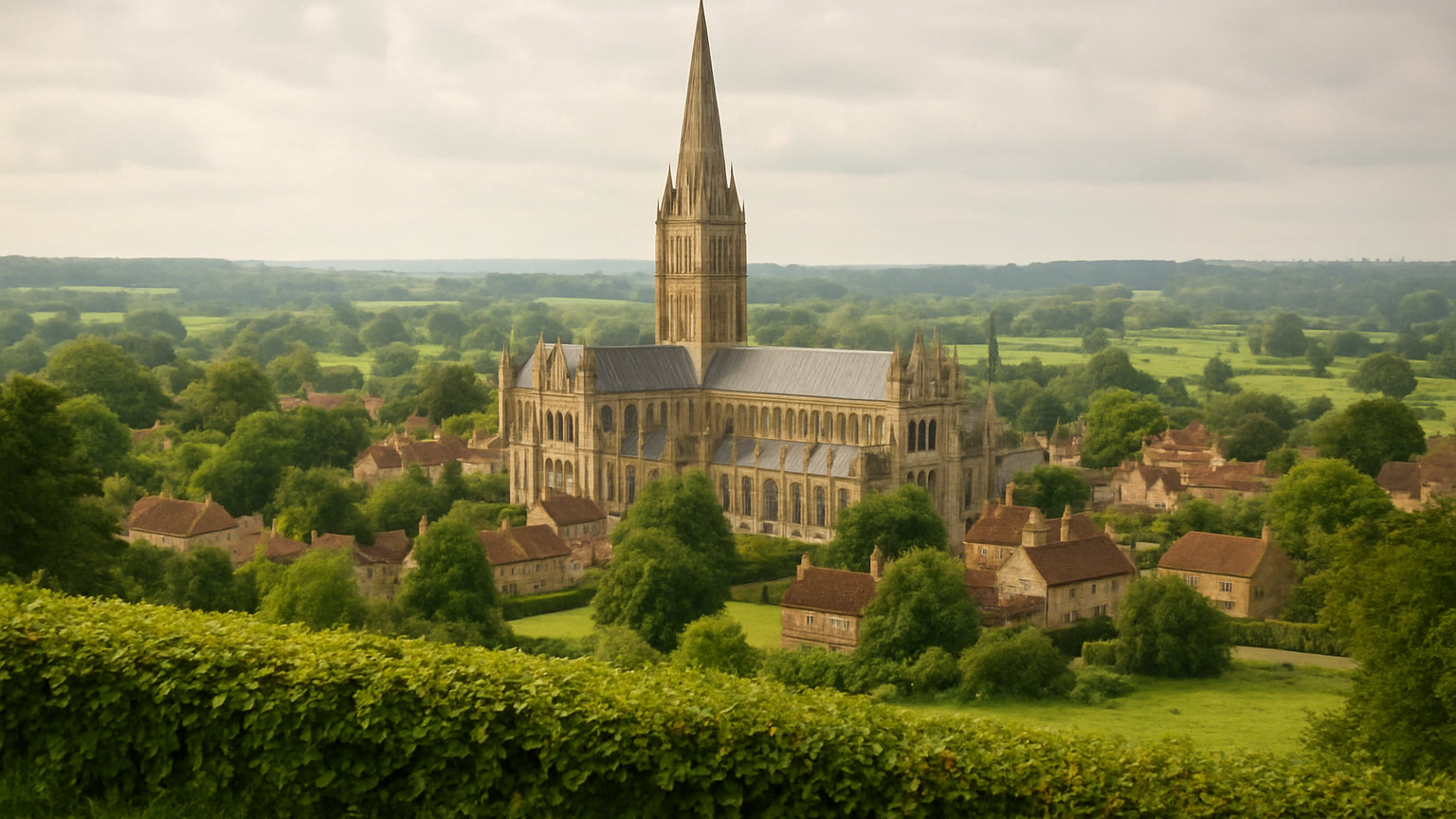
Salisbury has the tallest spire in Britain at around a hundred and twenty three metres, and has held the record since the sixteenth century. Before that the title belonged to Lincoln, whose central spire made it, by a considerable margin, the tallest building in the world.
How tall is Salisbury?
Around a hundred and twenty three metres to the tip, added a generation after the main church was completed and never intended in the original design.
The spire weighs enough that the piers beneath it visibly bend, and medieval bracing arches were inserted to hold it. Tower tours climb into the base of the spire, where the original wooden scaffolding is still in place.
What happened at Lincoln?
A spire added to the central tower in the fourteenth century took the cathedral to an estimated hundred and sixty metres, making it the tallest structure in the world and the first building to exceed the Great Pyramid.
It held that record for around two and a half centuries until the spire blew down in a storm in 1548 and was never replaced.
Which is the second tallest now?
Norwich, whose spire reaches around ninety six metres, added in the fifteenth century after the earlier one was destroyed.
Coventry's surviving medieval spire, standing beside the bombed ruin, is also among the tallest in England.
Which is the largest cathedral?
Liverpool's Anglican cathedral, by internal volume the largest in Britain and among the largest in the world, built between 1904 and 1978 in Gothic style.
Its tower is the tallest and heaviest of any cathedral tower, and it holds the highest and heaviest ringing peal of bells anywhere.
Which has the longest nave?
Winchester, whose overall length of around a hundred and seventy metres makes it the longest medieval cathedral in Europe.
Walking the length of it is the point of the building, since the Norman transepts and the Gothic nave were built four centuries apart.
What about St Paul's?
Its dome rises to around a hundred and eleven metres, which made it the tallest building in London for two and a half centuries.
The Old St Paul's it replaced had a spire of around a hundred and fifty metres, destroyed by lightning in 1561 and never rebuilt before the Great Fire.
Why were spires built so tall?
Partly devotion, partly civic and institutional competition between dioceses, and partly because the technology of the period allowed increasingly ambitious structures.
The limits were found the hard way. Several towers and spires collapsed, at Lincoln, Ely, Chichester, Winchester and elsewhere.
What happened at Ely?
The central tower collapsed in 1322 and was replaced not with another tower but with an octagonal space capped by a timber lantern.
It is unique in medieval architecture and is arguably a better building than what it replaced.
Which spires can you go up?
Salisbury runs tower tours into the base of the spire. Norwich, Lincoln, York, Durham and several others offer tower climbs to varying heights.
All involve substantial spiral stairs, all are booked in advance and all close in high wind.
Are the figures reliable?
Broadly, and they differ slightly between sources because of where the measurement starts and whether weathervanes are included.
Treat quoted heights as close approximations rather than exact figures, since cathedrals have been measured repeatedly and inconsistently.
Which is most impressive in person?
Salisbury for the spire, seen across the water meadows, which is the view painters have chosen for two centuries.
Lincoln for the position, since the cathedral stands on a ridge above a flat county and is visible for thirty miles in several directions.
Which are the hardest to see properly?
The ones hemmed in by buildings. Several cathedrals were built with a close or a market pressing right up to them, so no single viewpoint shows the whole exterior. Salisbury, Lincoln and Durham are exceptions, each having a setting that allows the building to be seen entire, which is part of why they photograph so well.