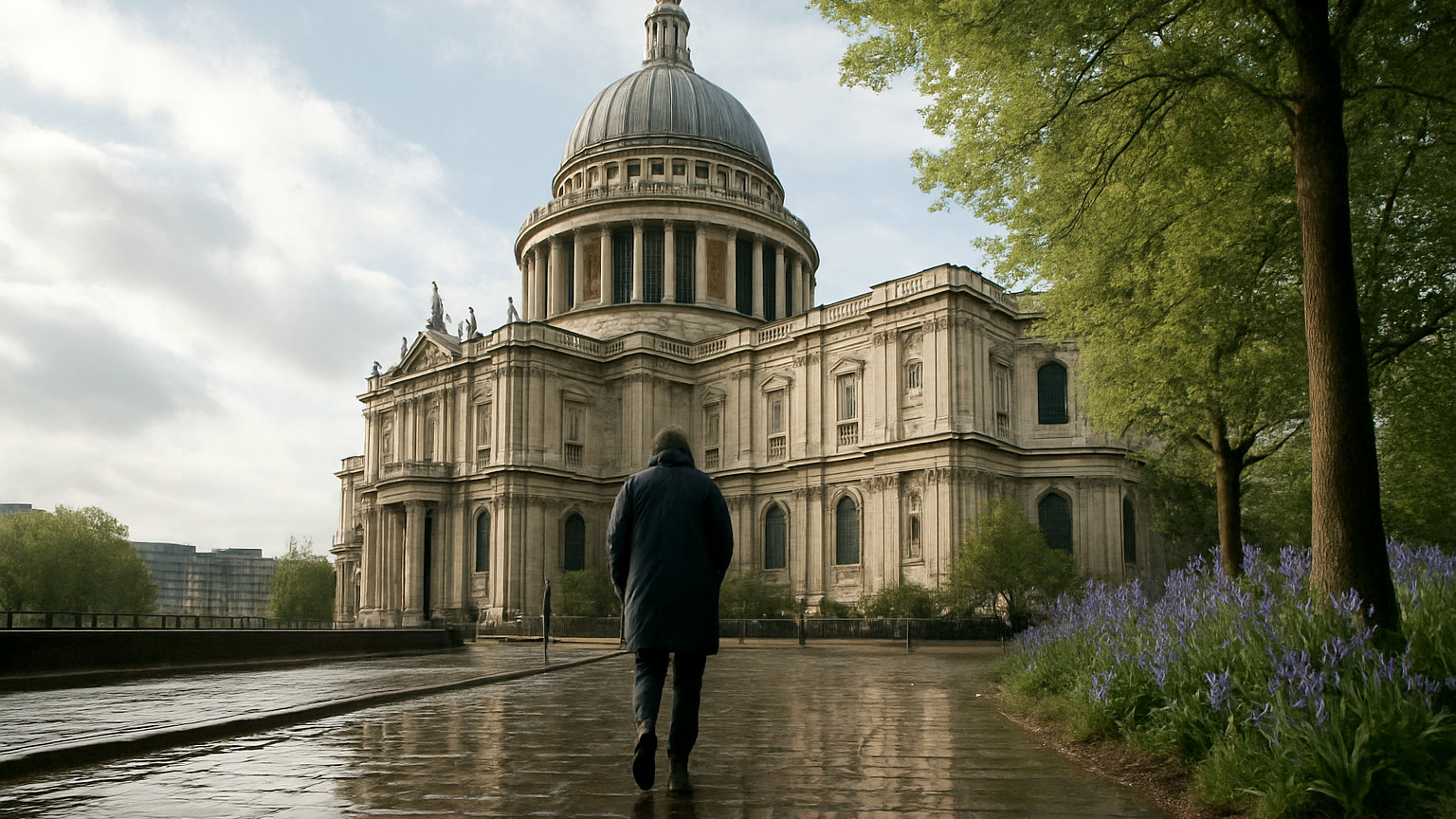
St Paul's is the fifth cathedral on the site and was built between 1675 and 1710 to replace the medieval building destroyed in the Great Fire of London. Its architect spent thirty five years on it and lived to see it finished, which almost no cathedral builder ever has.
How does the dome work?
It is three domes in one. An inner dome visible from the floor, a brick cone above it carrying the weight of the lantern, and an outer timber and lead dome shaped for the skyline.
That arrangement let the exterior look right without the interior being impossibly high, and it was structurally ingenious for its date.
What are the three galleries?
The Whispering Gallery inside the dome at around two hundred and fifty seven steps, where a whisper against the wall carries round to the far side.
The Stone Gallery outside at three hundred and seventy six steps, and the Golden Gallery at the top of the dome at five hundred and twenty eight, with a view over the whole city.
Is the climb difficult?
The first section is straightforward; the upper stages are narrow, steep and enclosed, with metal stairs inside the dome structure.
Anyone uneasy with heights or confined spaces should stop at the Whispering Gallery, which is worth the climb on its own.
Who is buried in the crypt?
Nelson, directly beneath the centre of the dome in a sarcophagus originally made for Cardinal Wolsey, and Wellington in an enormous porphyry tomb.
Also Wren himself, under a plain slab, with an inscription placed by his son directing the reader to look around at the building as his monument.
What else is in the crypt?
Memorials to a great many artists, scientists and military figures, the Order of the British Empire chapel, and the cathedral's treasury.
It runs beneath the entire building and is among the largest crypts in Europe.
What happened in the Blitz?
The cathedral was hit several times and survived, protected by a volunteer fire watch who patrolled the roofs and dealt with incendiary bombs as they landed.
A photograph of the dome standing above the smoke on the night of 29 December 1940 became one of the defining images of the war. A bomb that fell through the roof of the north transept was defused and removed.
What are the mosaics?
Victorian additions to the quire ceiling, in glass and gold, made when the interior was felt to be too plain and austere for the taste of the period.
They divide opinion. Wren's original scheme had none, and what you see is a considerably richer building than he intended.
What paintings are there?
Holman Hunt's Light of the World, a version painted late in his life by an artist by then almost blind, which he made specifically for the cathedral.
The dome carries monochrome scenes from the life of St Paul painted by James Thornhill.
Does it charge?
Yes, for sightseeing, at a level reflecting that it receives no state funding and costs a great deal to maintain. Booking online is cheaper than at the door.
Entry for worship is free, including for the daily services, and evensong is sung most days.
What is outside?
The west steps, the churchyard with its gardens, and the Millennium Bridge running south to Tate Modern, which gives the best modern view of the west front.
Paternoster Square behind holds Temple Bar, a Wren gateway moved here from Fleet Street.
When should you go?
At opening, since it is among the most visited buildings in Britain and fills quickly. Weekday mornings are noticeably better than weekends.
Allow two hours minimum, and considerably longer if you intend to climb to the top of the dome.
What is the Wren connection worth knowing?
He was appointed after the Great Fire, produced several rejected designs before the one that was built, and used a royal warrant allowing variations to change it substantially during construction. He was carried up to the lantern in a basket in old age to inspect the work, and he is buried in the crypt beneath the building he spent his life on.