Several buildings that were once cathedrals now stand roofless. The causes divide into three: the Scottish reformation, which left the great medieval churches without a use; deliberate destruction and fire; and, in one case within living memory, aerial bombing.
What happened at Elgin?
Described in its time as the lantern of the north, Elgin Cathedral was burned in 1390 by a nobleman known as the Wolf of Badenoch in a dispute with the bishop, and rebuilt.
After the reformation it lost its function, the lead was stripped from the roof, and the central tower fell in 1711. The shell, chapter house and two western towers survive and are among the finest ruins in Scotland.
What is at St Andrews?
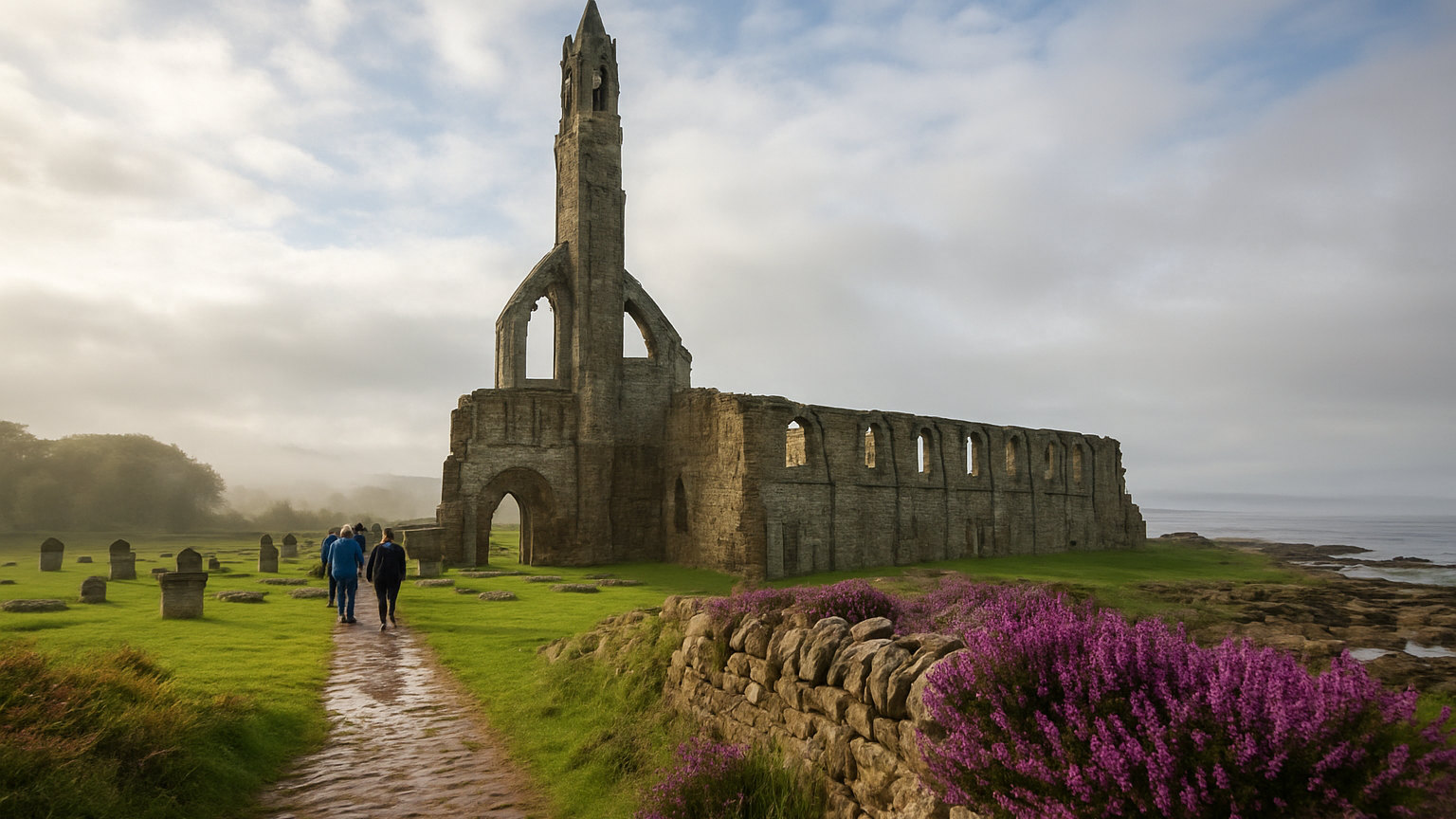
The remains of what was the largest church ever built in Scotland, consecrated in 1318 and abandoned after the reformation in 1559.
Gable ends and fragments of wall stand above the burial ground, with St Rule's Tower beside it, which can be climbed for a view over the town and the sea.
Why did Scotland lose so many?
Because the Scottish reformation was more thorough than the English one and produced a presbyterian church with no bishops and therefore no use for cathedrals.
Some, like Glasgow, were retained as parish churches and survived intact. Others were simply left, and without maintenance the roofs went within a generation or two.
What happened at Coventry?
The cathedral burned in a single night of bombing in November 1940, leaving the tower, spire and outer walls standing.
The decision was taken to preserve the ruin rather than clear it, and a new cathedral was built at right angles to it and consecrated in 1962. The two are experienced as one building.
What is in the Coventry ruin?
A cross made from charred roof beams found in the wreckage, an altar of rubble, and the words Father Forgive inscribed on the wall behind it.
The city chose reconciliation rather than only remembrance and formed links with other bombed cities including Dresden. The ruin is free to enter.
What is Old Sarum?
An Iron Age hillfort near Salisbury, reused by the Normans, who built a castle and a cathedral inside the ramparts before the clergy moved down to the valley in the thirteenth century.
The foundations of the cathedral are laid out in the turf, and the site explains exactly why they left: it was exposed, waterless and dominated by the garrison.
What happened at Dunwich?
Not a cathedral loss exactly, but a bishopric and a substantial medieval town on the Suffolk coast lost almost entirely to erosion over several centuries.
What remains is a hamlet, a beach and the ruins of a friary on the clifftop, with the medieval town beneath the sea.
Which others are ruined in Scotland?
Whithorn in Galloway, an early Christian site of considerable importance, and Fortrose on the Black Isle, both partial ruins in care.
Dunkeld's choir survives as a working church with the nave roofless beside it, which shows the process halfway through.
What about abbeys?
Fountains, Rievaulx, Whitby, Tintern and Glastonbury were abbeys rather than cathedrals, and were destroyed at the dissolution because they had no diocesan function to save them.
Several monastic churches that did become cathedrals, including Gloucester, Chester and Peterborough, survive complete for exactly that reason.
Are they worth visiting?
Very. A roofless building shows its structure in a way a complete one cannot, and the scale of Elgin or St Andrews is more apparent without a roof.
Most are in the care of national heritage bodies, are inexpensive and are far quieter than working cathedrals.
What should you look for?
The line of the vaulting on the walls, the springing of arches, and the sockets where floors and roofs sat, which together let you reconstruct the interior.
Carved detail frequently survives on doorways and capitals where it was sheltered, and burial grounds around these sites are usually worth an hour.