Rome held Britain for close to four hundred years, longer than the gap between now and the English civil war. What survives is scattered but substantial: a frontier wall across the north, bath complexes, villas with mosaic floors, town walls and a road network still visible in the modern map.
What is the single best site?
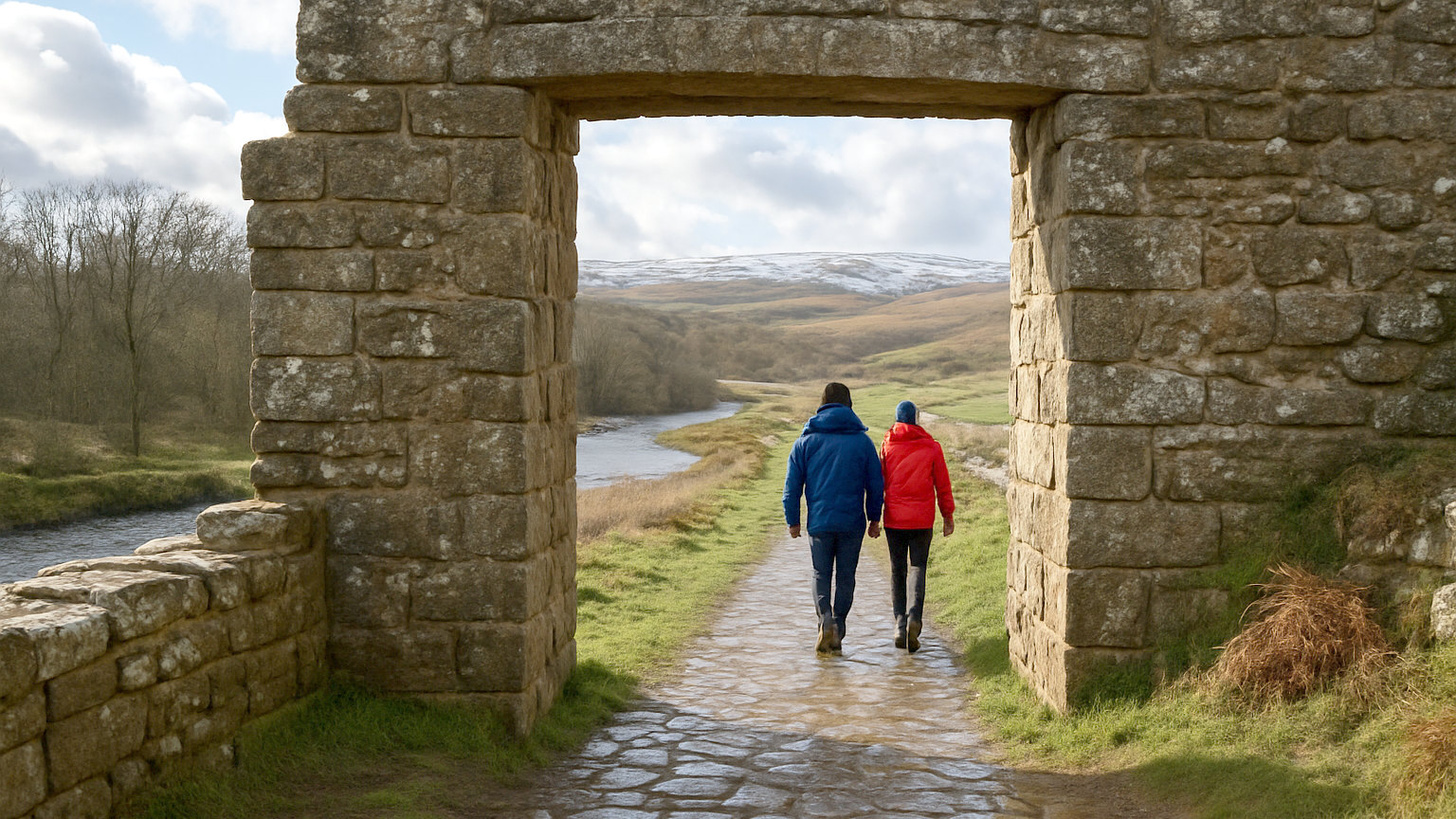
Hadrian's Wall, and specifically the central section between Chollerford and Greenhead in Northumberland, where the wall runs along the crags and the scale becomes clear.
Housesteads is the most complete fort, Vindolanda has ongoing excavation and a remarkable collection of writing tablets, and Chesters has the best preserved cavalry fort and bath house. The Roman Army Museum covers the wider frontier.
What was the Antonine Wall?
The later and shorter frontier across central Scotland, built of turf rather than stone and held for around twenty years before the frontier fell back to Hadrian's Wall.
Less survives, though earthworks are visible at several points and Rough Castle near Falkirk is the best preserved. Like Hadrian's Wall, it forms part of a transnational World Heritage Site covering the Roman frontiers.
Where can you see Roman baths?
Bath, where the complex around the hot spring is the most complete Roman remains in Britain and among the finest in northern Europe. The water still rises at the temperature it always did.
Smaller bath houses survive at Chesters, Ravenglass in Cumbria, which stands to a remarkable height, and at Wroxeter in Shropshire, where a substantial wall of the baths basilica remains standing.
Which villas are worth visiting?
Fishbourne in Sussex, the largest Roman residence found north of the Alps, with an outstanding collection of mosaics and a reconstructed garden. Chedworth in Gloucestershire, in a wooded valley with fine mosaics and a hypocaust.
Bignor in Sussex and Lullingstone in Kent both have excellent floors. Villas were working estates rather than holiday homes, and the best sites explain the agricultural context as well as the mosaics.
What about Roman towns?
Wroxeter, once the fourth largest city in Roman Britain, now a field with a substantial wall and a reconstructed town house. Verulamium at St Albans, with a theatre, town walls and a museum of mosaics.
Caerleon in south Wales has an amphitheatre, barracks and baths from a legionary fortress. Chester has the largest Roman amphitheatre in Britain, partly excavated beside the city walls. Silchester in Hampshire is an entire town outline in fields.
Can you still see Roman roads?
Constantly, if you know where to look. Long straight sections of modern road frequently follow Roman alignments, and stretches of original surface survive on moorland where later roads diverged.
Wade's Causeway on the North York Moors is the best known upland stretch. Watling Street, Ermine Street and the Fosse Way are all traceable on a map across large parts of England.
What is at Vindolanda specifically?
An active excavation that has run for decades, where the waterlogged ground has preserved leather, wood and textiles that survive almost nowhere else.
The writing tablets found there, thin slivers of wood carrying everyday correspondence including a birthday invitation, are among the most important finds from Roman Britain. Excavation continues through the summer and visitors can watch.
What should you look for on site?
Hypocausts, the underfloor heating systems, visible as short stacks of tiles supporting a floor. Mosaics, and whether they are in situ or relaid. The playing card shape of a Roman fort, rounded at the corners.
Also reused Roman stone in later buildings, which is common near any Roman site and turns up in churches, farms and castle walls throughout the country.
How should you plan a trip?
Hadrian's Wall justifies three or four days on its own, ideally walking a section rather than driving between car parks. Bath and Fishbourne can be combined with the south coast.
Several sites are free or covered by heritage membership, and the museums attached to the wall forts are considerably better than their size suggests.