Britain built more cathedrals in the twentieth century than in any period since the middle ages, and several are among the more significant buildings of their time. Two of the most interesting stand at either end of the same street in Liverpool and could hardly be less alike.
What is Liverpool's Anglican cathedral?
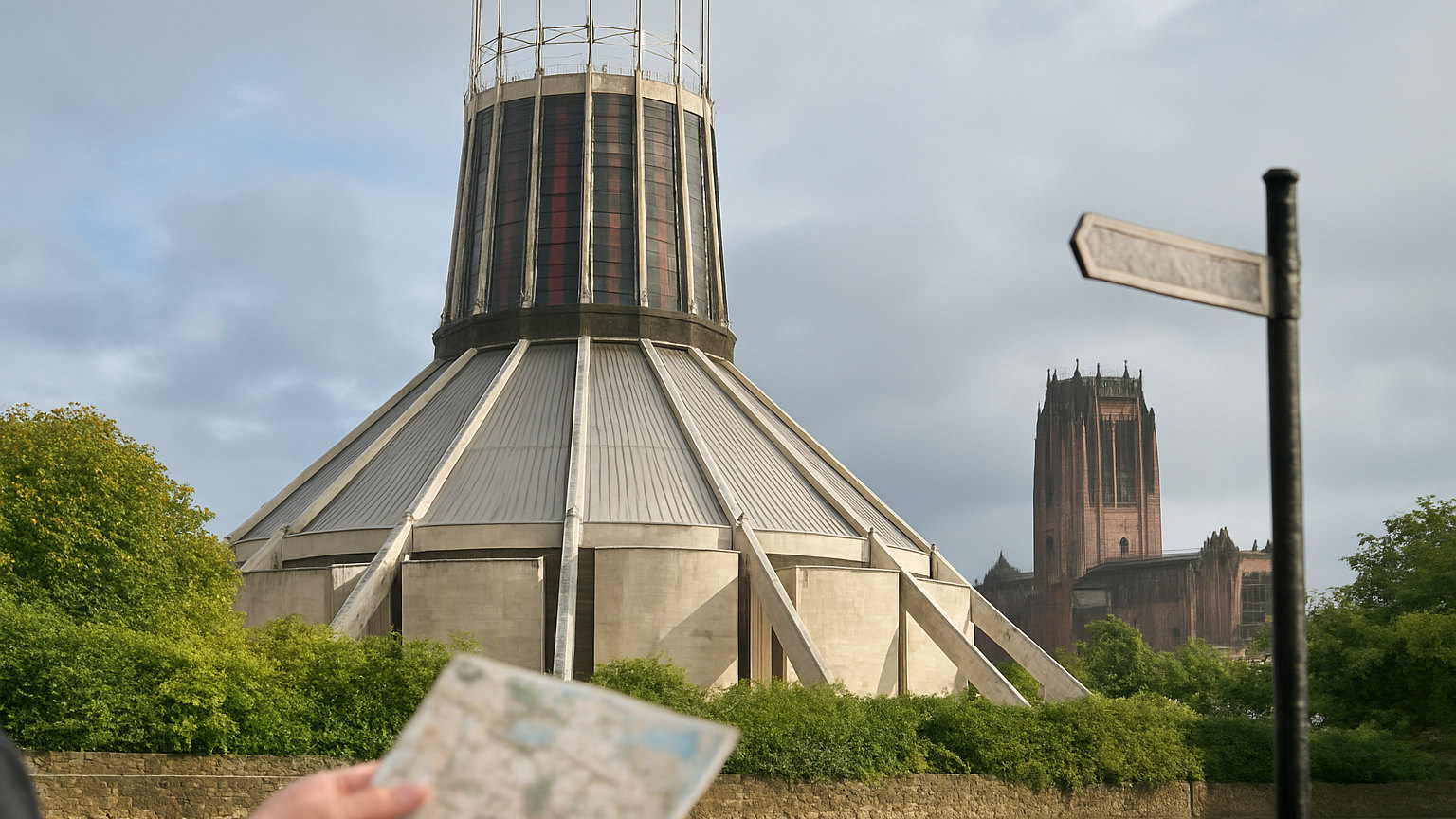
An enormous Gothic building begun in 1904 and finished in 1978, designed by an architect who won the competition at twenty two and had never built a church.
It is the largest cathedral in Britain by volume, has the highest and heaviest ringing peal of bells anywhere, and a lift and stairs take visitors to the top of the tower.
What is the Metropolitan Cathedral?
The Catholic cathedral at the other end of Hope Street, consecrated in 1967, circular in plan with a lantern tower of stained glass above a central altar.
It replaced a far larger design that was abandoned after the war, and the crypt of that scheme survives beneath it and can be visited.
Why are they so different?
Because they were built sixty years apart to entirely different theological and architectural assumptions, one facing backwards to the Gothic and the other forwards.
Walking between them along Hope Street takes fifteen minutes and is among the most instructive walks in British architecture.
What makes Coventry important?
It was built beside the bombed ruin of its predecessor rather than replacing it, connected by a porch, so the two are experienced together.
It holds an enormous tapestry behind the altar, an engraved glass screen, a baptistry window set in a wall of concrete and a bronze of the archangel Michael outside.
What is at Guildford?
A brick cathedral on a hill above the town, begun in the 1930s and consecrated in 1961, with a plain and light interior and a stag weathervane visible for miles.
Many of the bricks were bought individually by local people who signed them, which are still visible inside.
What about Clifton?
The Catholic cathedral in Bristol, completed in 1973, hexagonal in plan and built in concrete, which makes it among the more uncompromising modern churches in Britain.
It was designed so that no worshipper is more than fifteen metres from the altar, which is the point of the shape.
Are there others?
Brentwood, rebuilt in the 1990s in a classical revival style that pointedly rejected modernism. Portsmouth, Northampton and Middlesbrough all have twentieth century Catholic cathedrals.
Truro, though nineteenth century, was the first Anglican cathedral built on a new site since the reformation.
Why did so many get built?
New dioceses were created as populations moved and grew, particularly in industrial cities, and Catholic emancipation eventually allowed substantial Catholic building.
Wartime destruction accounted for Coventry, and post war optimism and public subscription funded a good deal of the rest.
How were they received?
Variably, and several were controversial when built. Modern religious architecture divides opinion more sharply than almost any other kind.
Time has been kinder to most of them, and Coventry in particular is now regarded as among the finest British buildings of its century.
What should you look for?
Light, which is what these buildings are mostly about, and how the seating relates to the altar, which reflects changing thinking about worship.
Commissioned artwork, since several employed leading artists of the day, and the way each building responds to what stood before it.
Where should you start?
Liverpool, for the two together in one afternoon, or Coventry for the single most affecting example.
Both are free to enter, both are in cities worth a day anyway, and both reward more time than visitors usually give them.
What about the wider precincts?
Modern cathedrals frequently sit in deliberately designed settings rather than medieval closes, and the approach matters. Coventry's ruin and new building share a single site; Liverpool's Anglican cathedral stands above a former quarry now used as a garden and burial ground, which is worth walking round before going in.