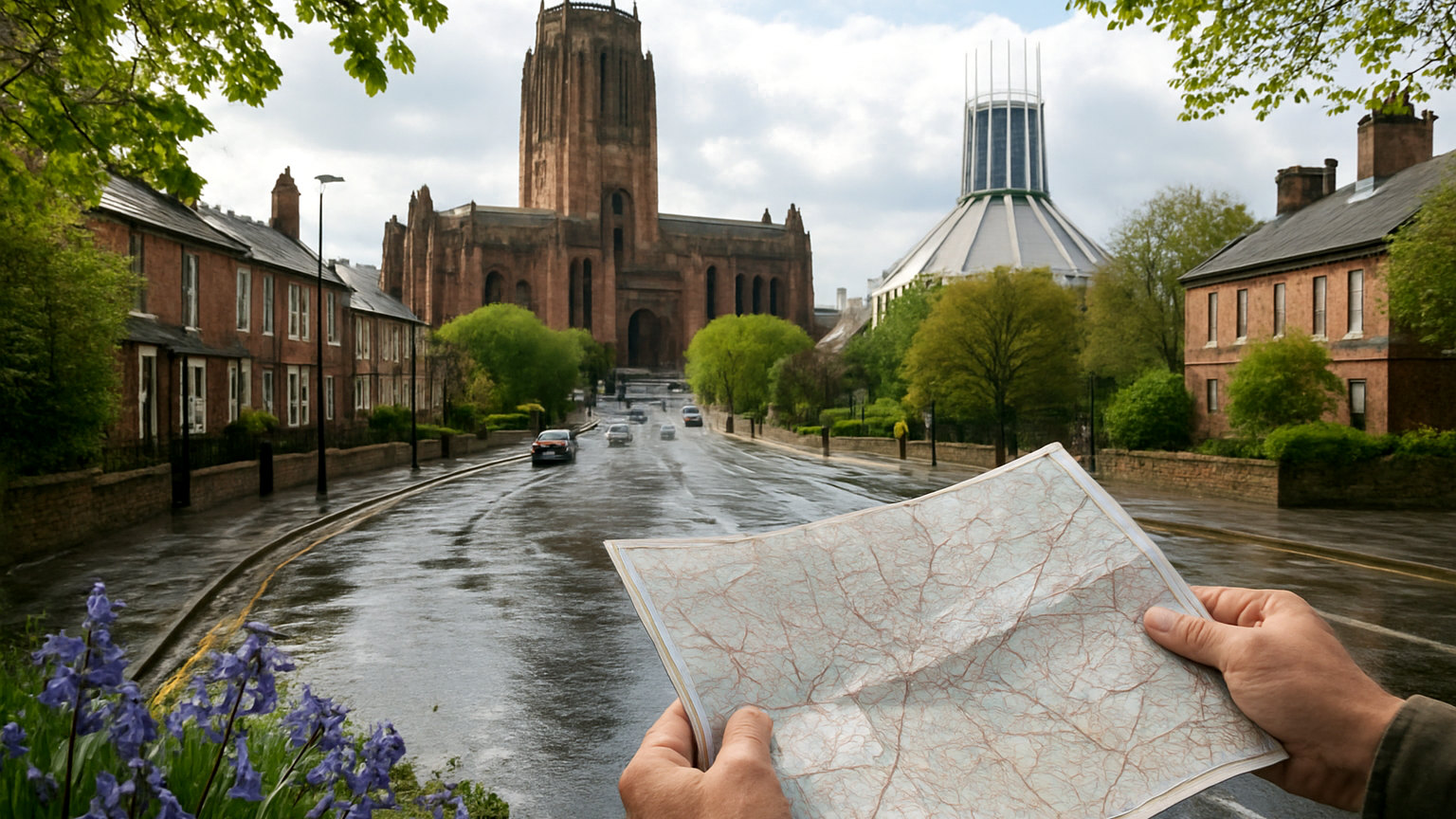
Liverpool has two cathedrals standing at either end of a street called Hope, built sixty years apart to entirely different assumptions about what a cathedral should be. Walking between them takes fifteen minutes and is among the most instructive walks in British architecture.
What is the Anglican cathedral?
The largest cathedral in Britain by volume and among the largest in the world, built in Gothic style between 1904 and 1978, so that it took most of the twentieth century to complete.
The scale inside is difficult to convey. The central space is enormous and the arches are the largest Gothic arches ever built.
Who designed it?
Giles Gilbert Scott, who won the competition in 1903 at twenty two years old, had never built a church, and was a Roman Catholic designing an Anglican cathedral.
He revised the design substantially during construction and worked on it for over fifty years until his death.
Can you go up the tower?
Yes, by two lifts and a final flight of steps to the top, which at around a hundred and one metres gives a view over the city, the Mersey and out to the hills of north Wales.
Because most of the ascent is by lift, it is accessible to people who could not manage a medieval spiral stair.
What are the bells?
The highest and heaviest ringing peal of bells in the world, hung in the tower, which is a genuine record rather than a local claim.
They are rung regularly and can be heard across a considerable part of the city.
What is the Metropolitan Cathedral?
The Catholic cathedral at the other end of Hope Street, consecrated in 1967, circular in plan with the altar at the centre and a lantern tower of stained glass above it.
The coloured light falling into the centre is the whole idea of the building, and the effect changes completely with the weather and the hour.
Who designed that one?
Frederick Gibberd, who won an open competition in 1959 for a building that could be constructed quickly and affordably on an existing foundation.
It is known locally by an affectionate nickname referring to its shape, which residents use without any disrespect.
What is the crypt beneath it?
The surviving fragment of a far larger cathedral designed by Edwin Lutyens in the 1930s, which would have had the second largest dome in the world and was abandoned after the war on cost.
The crypt was built and remains, in brick and granite, and is open to visitors. It is a remarkable space and gives a sense of the scale of what was intended.
Why are they so different?
Because they were designed sixty years apart, one looking back to the middle ages and one forward, and because Catholic thinking about worship changed substantially in between.
The Metropolitan Cathedral's circular plan puts no worshipper far from the altar, which was a deliberate liturgical decision.
Do they charge?
Entry to both is free with donations invited. The Anglican tower and some exhibitions are ticketed, and the Lutyens crypt has its own arrangements.
Both hold regular services and both have cafes.
What is Hope Street?
The street between them, holding two theatres, the university's Georgian quarter, restaurants and a sculpture of suitcases on the pavement.
It is among the best short walks in any English city and the two cathedrals are visible from each other along it.
How long do you need?
An hour in each, plus the tower and the crypt, which makes a comfortable half day for both.
Doing them in one visit rather than separately is the point, since the contrast is the interesting part.
What else is around the Anglican cathedral?
It stands above St James's Gardens, a former quarry used as a cemetery in the nineteenth century and now a park, with ramps and vaults cut into the rock face. Walking round it before going in explains why the building sits where it does and gives the best view of the tower from below.