A crypt is usually the oldest surviving part of a cathedral, built first and left in place when everything above was rebuilt. They are frequently the most atmospheric spaces in these buildings and are consistently missed by visitors heading for the nave.
Which is the largest?
Canterbury, whose Norman crypt of the early twelfth century is generally described as the largest of its kind in the world.
It has carved capitals of extraordinary quality, wall paintings surviving in one chapel, and it held Becket's tomb before the shrine was built above.
What is at Worcester?
A Norman crypt of 1084, among the largest and earliest in England, with a forest of plain round columns and simple cushion capitals.
It is the oldest part of the cathedral and considerably older than everything visible from the nave.
What is unusual about Winchester?
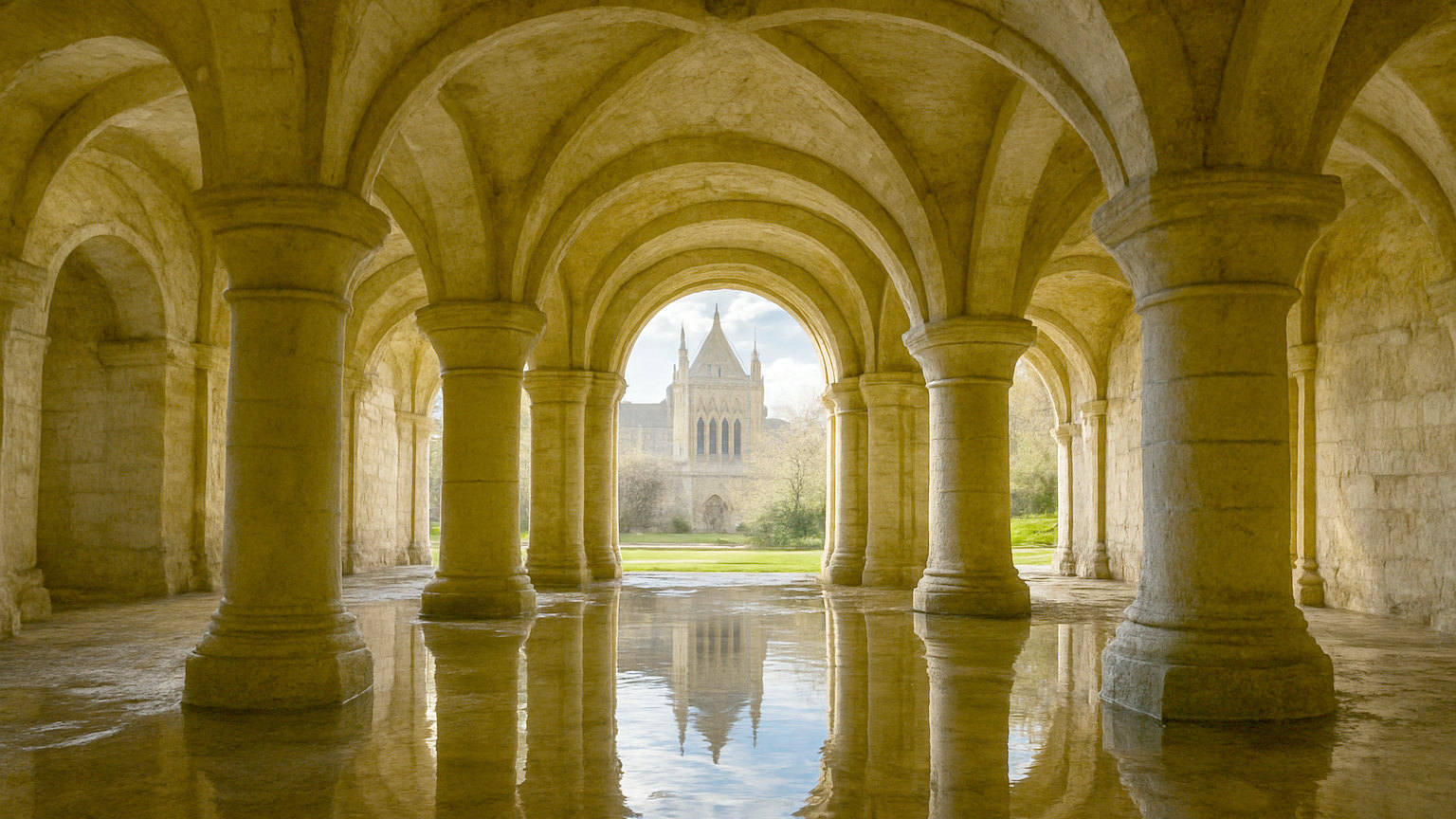
It floods. The cathedral was built on peat and a high water table, and the crypt fills with water for part of most years.
A standing figure by a well known sculptor is sited in it, so that in winter the statue stands in still water reflecting the vaulting, which is among the most striking sights in any English cathedral.
How was Winchester saved?
In the early twentieth century the building was sinking and a single diver worked underwater in the flooded foundations for several years, packing them with bags of concrete.
He is credited with saving the cathedral and is commemorated inside it.
Which are Saxon?
Ripon and Hexham both have crypts from around the seventh century, built by the same founder and surviving almost intact beneath much later churches.
Hexham's was constructed from stone robbed out of a Roman fort, and some blocks still carry Roman inscriptions.
What is at Glasgow?
The lower church, built to house the tomb of the city's patron saint on sloping ground, which is generally regarded as the finest medieval space in Scotland.
Glasgow Cathedral survived the reformation largely intact, which is unusual north of the border, and the lower church is the best of it.
What is York's undercroft?
An excavated space beneath the central tower, created when the foundations were underpinned in the twentieth century, revealing Roman and Norman remains beneath the minster.
It is now a museum showing the layers of building on the site, from the Roman fortress upwards.
What about St Paul's?
An enormous crypt running under the whole building, holding the tombs of Nelson and Wellington and memorials to a great many others, including Wren himself.
It is among the largest crypts in Europe and functions partly as a national mausoleum.
What else survives in crypts?
Wall paintings, which are rare above ground and occasionally survive below. Carved capitals, tombs, and in several cases relics of earlier buildings entirely.
Rochester and Gloucester both have substantial Norman crypts worth the descent.
Why are they so well preserved?
Because they were structural and unfashionable. Rebuilding upwards was expensive and visible; rebuilding a crypt achieved nothing anyone would see.
They were also used for storage and burial rather than display, which kept them out of the way of iconoclasts and improvers alike.
What should you know before visiting?
They are cold, dimly lit and reached by steps, and some are closed for services or events at short notice.
Several are included in general admission and a few are ticketed separately. Take a layer, since the temperature difference from the nave is substantial.
Are any used for anything?
Several. Crypts host exhibitions, cafes, chapels and concerts, and at York the undercroft is a full museum. Others hold treasuries displaying plate and vestments. A few remain simply empty and unlit, which is arguably the better experience if you want to understand what the space actually is.
One last suggestion: go down to the crypt first rather than last. It is the oldest part of the building and starting there makes the chronology of everything above considerably easier to follow.