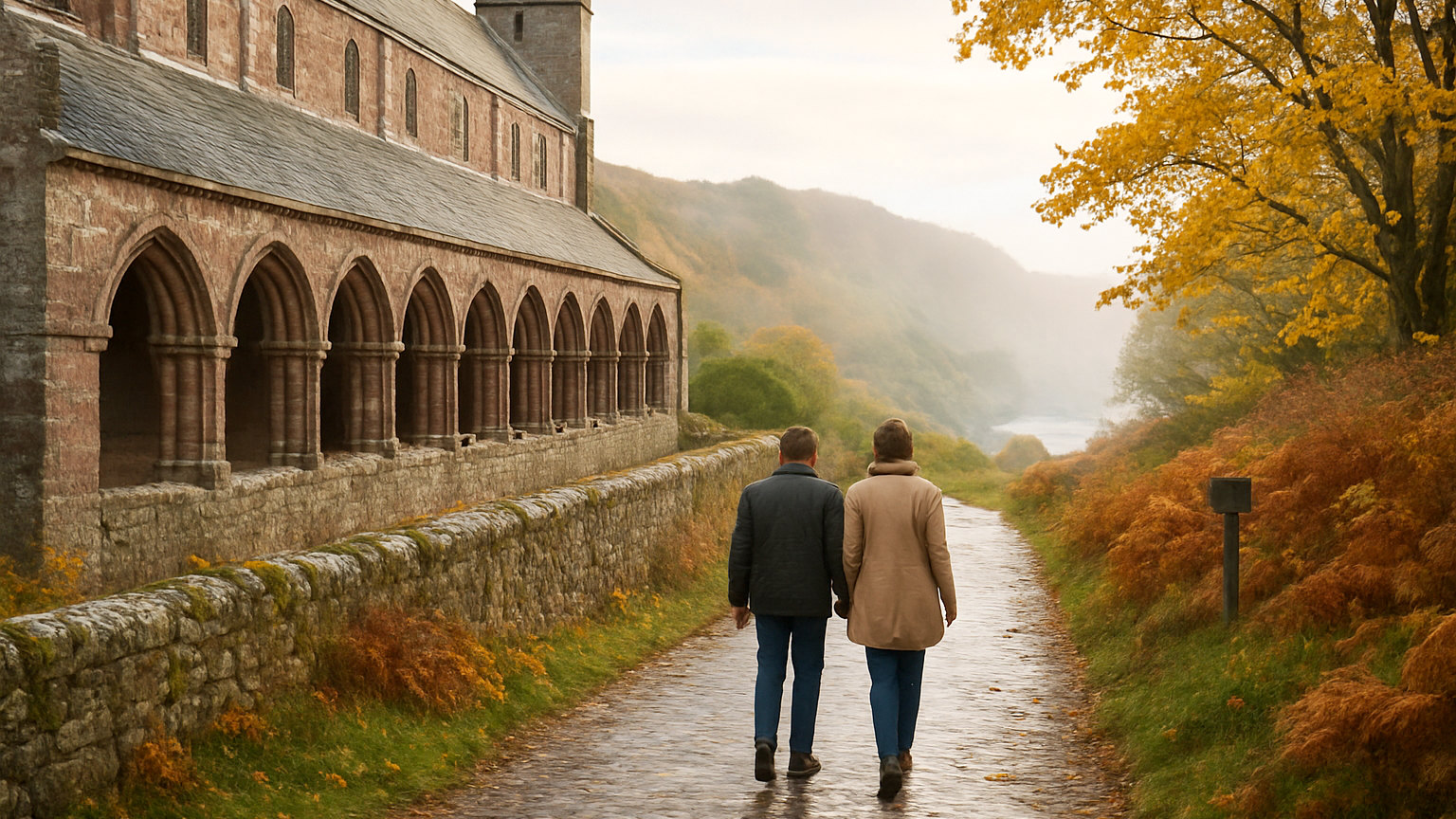
A cloister is a covered walkway around an open square, built for monastic communities to move, read and work in shelter. They survive at cathedrals that were monastic foundations before the reformation, which is why some have them and others never did.
Which is the most famous?
Gloucester, which carries the earliest fan vaulting in England, developed here in the fourteenth century and later used across the country.
It is the finest example anywhere and the effect of the repeated fans down the length of the walk is unlike any other space in English architecture.
Which is the largest?
Salisbury has the largest cathedral cloister in England, which is faintly odd since the cathedral was never monastic and had no practical need for one.
It was built for effect and for processions, and encloses two enormous cedar trees planted in the nineteenth century.
What is special about Norwich?
It has the largest monastic cloister in England and around a thousand carved roof bosses, more than any other building in the world.
They depict biblical scenes, foliage, animals and grotesques, and mirrors are provided so you can look at them without straining your neck.
What is at Canterbury?
A great cloister with hundreds of heraldic bosses recording the arms of families who contributed to the rebuilding after a fire.
The surrounding monastic buildings, including the chapter house and the water tower, survive more completely here than almost anywhere.
Which others are worth seeing?
Wells, with a library above one walk and a memorial garden within. Chester, with a monastic layout that survives unusually well.
Durham, where the cloister connects to the monks' dormitory, now a library with a fourteenth century timber roof, and the great kitchen.
What should you look for?
Roof bosses, which carry the best carving and are almost always overlooked. Carrels, the recesses where monks sat and read, still visible at Gloucester.
The lavatorium, a washing trough near the refectory door, and doorways whose positions reveal where vanished buildings once stood.
What is a chapter house?
The room where the community met daily to hear a chapter of the rule read and to conduct business, usually reached from the cloister.
Several are architecturally remarkable in their own right, including the octagonal examples at Wells, Salisbury, Westminster and York, and the circular one at Worcester.
Why do some cathedrals have none?
Because they were secular foundations staffed by canons living in their own houses rather than by a monastic community, and so had no use for one.
Lincoln, York, Exeter, Hereford and Chichester were all secular, and where they have cloisters these are generally later additions.
What happened after the dissolution?
Monastic cathedrals were refounded with deans and chapters, which preserved the buildings, while abbeys without cathedral status were mostly stripped and ruined.
That is why Gloucester and Chester survive complete and Fountains and Rievaulx are roofless.
When are they best?
Early morning and late afternoon, when low sun comes through the openings and throws the tracery across the floor and the opposite wall.
Cloisters are also the quietest part of most cathedrals and are free to walk in even where the church charges.
What else survives around them?
Refectories, dormitories, infirmaries and gatehouses, converted to schools, libraries and houses at several cathedrals.
Walking the precinct rather than only the church shows how a monastic community actually functioned, which the church alone does not.
Are they used for anything now?
Yes. Cloisters host exhibitions, concerts, cafes and memorials, and several are used for filming, which brings a steady stream of visitors who came for that reason. They also remain processional routes on major feast days, which is what they were built for and is worth seeing if you can time a visit for one.
One last point: cloisters are among the few parts of a cathedral where you can sit for a while without being in anyone's way, which on a long day of sightseeing is worth more than it sounds.