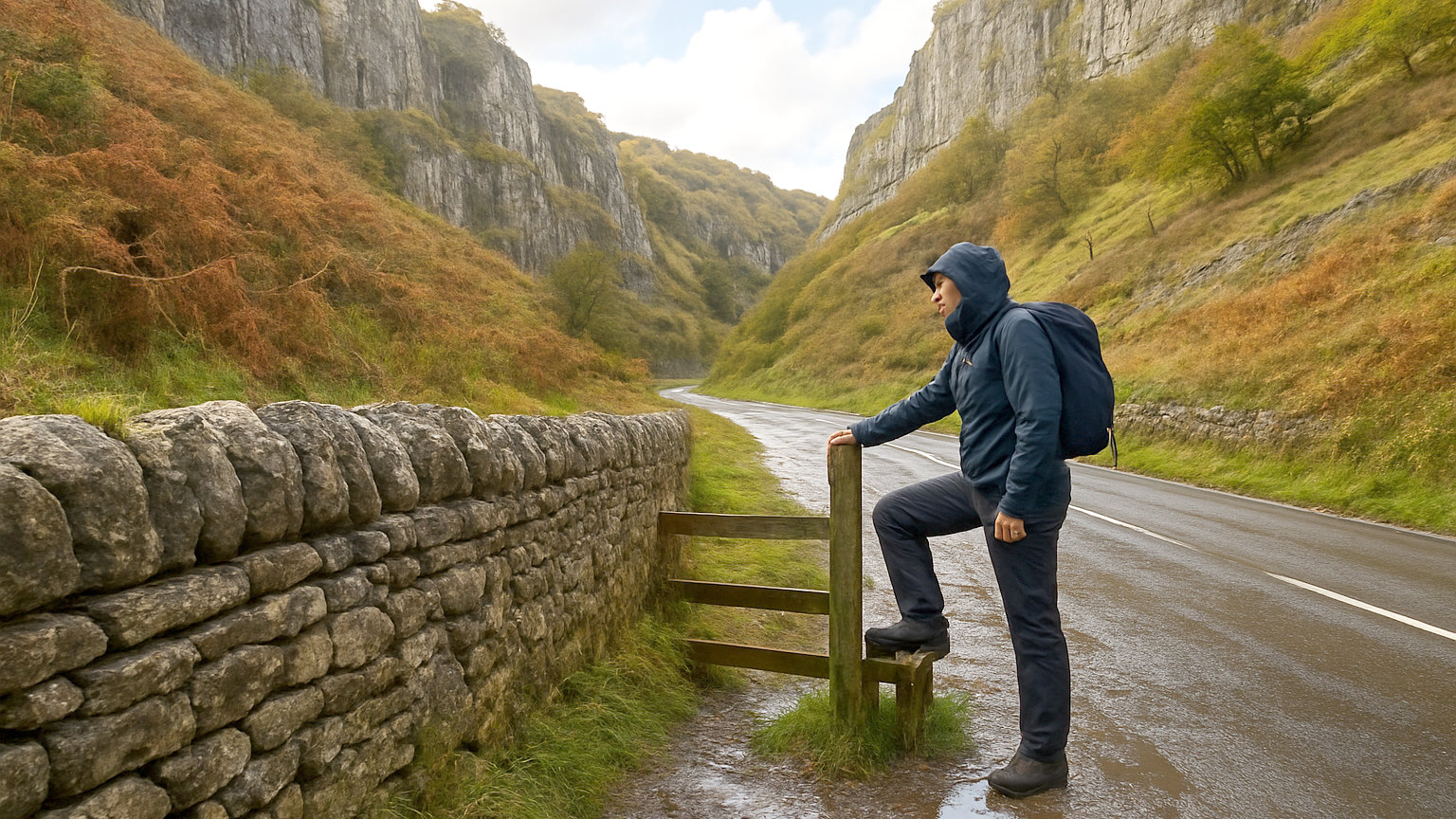
Cheddar Gorge is the deepest gorge in Britain, with limestone cliffs rising around a hundred and thirty metres directly from a road that runs through the middle of it. The drive takes ten minutes and is among the most dramatic short stretches of road in England.
What is the drive actually like?
Steep sided and enclosed, with the cliffs rising vertically on both sides and the road twisting between them, opening out gradually as you climb towards the top.
Drive it upwards from the village for the better effect, since the walls close in as you go rather than opening out behind you.
When should you drive it?
Early in the morning or in the evening, and outside summer weekends. The bottom of the gorge is heavily congested from mid morning in season.
Winter mornings with frost on the cliffs and no traffic are the best of all, and the road is rarely closed.
What should you watch for?
Cyclists, who use the gorge constantly and climb slowly. Walkers crossing between car parks and viewpoints. Feral goats, which graze the cliffs and come down to the road.
Rockfall is a genuine hazard and the road has been closed for stabilisation work at times. Do not stop beneath the cliffs to take photographs.
Where can you park?
In the village at the bottom, where parking is charged and fills early, and in one or two laybys higher up, which are limited.
There is nowhere to stop safely along much of the road itself, so plan to park and walk rather than pulling over.
What are the caves?
Two show caves at the bottom of the gorge, with lit walkways through chambers of stalactites and flowstone, ticketed together with other attractions.
Gough's Cave produced Cheddar Man, a complete skeleton around nine thousand years old, which is the oldest complete human skeleton found in Britain.
What was found out about Cheddar Man?
DNA analysis published in 2018 indicated he probably had dark skin and blue eyes, which changed assumptions about the appearance of the earliest post glacial population of Britain.
A reconstruction is displayed at the caves and the finding attracted considerable public attention.
Is there a walk?
Yes, and it is far better than the drive. A circular clifftop walk of around three miles runs along both rims, giving views down into the gorge that you cannot get from the road.
It involves a substantial climb, including a flight of several hundred steps at one end, and is well worth the effort.
What about the cheese?
Cheese was matured in the caves for centuries because of the constant temperature, and some is still stored in the gorge today.
The village sells a great deal of cheese, some of it genuinely local farmhouse cheddar and a good deal of it not, so ask where it was made.
What else is on the Mendips?
Wookey Hole, another show cave system a few miles away, and Ebbor Gorge, a smaller wooded gorge that is quiet and free.
The Mendip plateau above holds old lead workings, Iron Age remains and open walking with views across the Somerset Levels.
What is the wider drive?
The gorge road continues onto the top of the Mendips, giving a longer route across the hills towards Wells or Bath, with views over the Levels.
Combining it with Wells, six miles away, makes a good half day.
Is it worth it?
The gorge itself, yes, unreservedly. The commercial development at the bottom divides opinion sharply and is easily avoided by parking at the top and walking.
Anyone expecting a quiet natural wonder should go in February at eight in the morning, when it is exactly that.
What should you know about the caves?
They are ticketed together on a single pass covering both show caves, a museum and a lookout tower, valid for the day. The caves are cool year round, the walkways are wet in places and there are steps. Booking ahead in summer is sensible. The deeper adventure caving trips are separate and require booking well in advance.