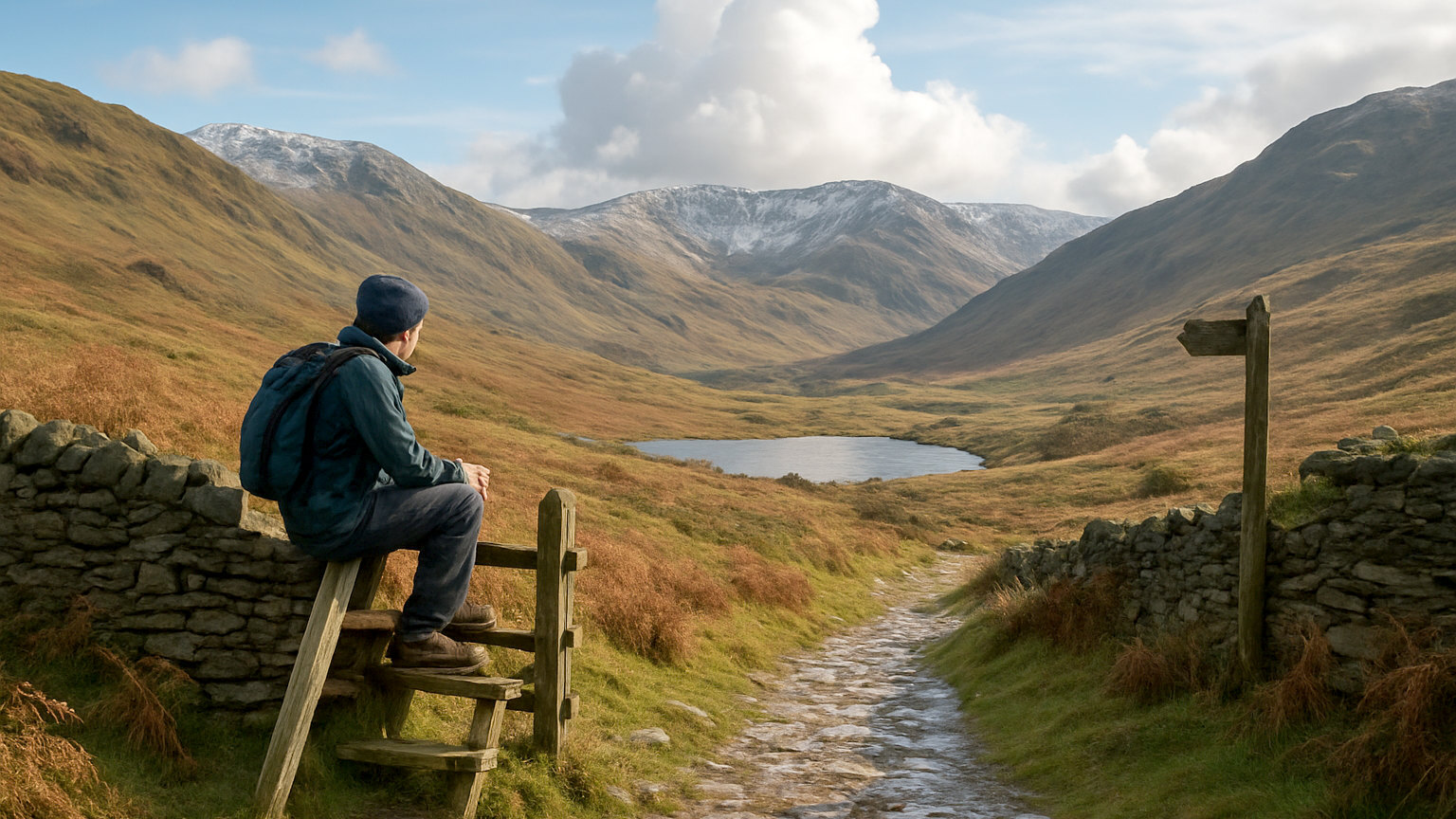
The most important skill in British hill walking is not navigation or fitness but the willingness to abandon a plan. Mountain rescue statistics are full of people who continued because they had booked accommodation ahead, because they had driven a long way, or because turning back felt like failure.
How quickly does it change?
Within an hour, routinely. Britain sits where Atlantic and Arctic air meet and weather fronts cross the country in a few hours, and mountains generate their own conditions on top of that.
Cloud base can drop below a summit while you are climbing towards it, and a ridge that was pleasant in the morning can be untenable in wind by lunchtime.
What should you check before setting out?
A mountain specific forecast rather than a town one. These give freezing level, cloud base, wind speed at summit height and a hazard assessment, none of which appear in a general forecast.
Wind speed is the figure that most often decides whether a route is sensible. Walking on an exposed ridge becomes difficult well below the speeds that sound alarming on a coastal forecast.
What is an escape route?
A pre identified way off the hill that is shorter, lower and safer than continuing. Every mountain day should have at least one, worked out at home rather than in cloud.
Typically it is a valley path, a col with a track down or a road crossing. Knowing where they are converts a difficult decision into a simple one.
When should you turn back?
When conditions are worse than forecast, when anyone in the group is struggling, when you are behind schedule enough to finish in darkness, or when visibility has closed in and you are unsure of your position.
A useful discipline is to set a turnaround time before starting and keep to it regardless of how close the summit looks. Most incidents involve people who pressed on for another twenty minutes.
What are the signs of hypothermia?
Shivering, then clumsiness, stumbling and difficulty with simple tasks such as fastening a zip. Slurred speech, confusion and irrational behaviour, including insisting they are fine or wanting to lie down, are later and serious signs.
Act at the early stage. Get the person into shelter and extra layers, replace wet clothing if possible, give warm sweet drinks if they are fully conscious, and descend. Do not wait to see whether it improves.
What about river crossings?
Rivers rise fast and fall slowly after rain, and a stream that was a step across in the morning can be impassable by afternoon. People drown in British rivers attempting crossings every year.
If a crossing looks doubtful, it is. Walk upstream to find a bridge, or turn back. Never cross water that is above knee deep and moving quickly, and never cross alone.
What should you do if someone is injured?
Get them insulated and sheltered first, using a group shelter or survival bag, since exposure will harm them faster than the injury. Then call 999 and ask for the police, then mountain rescue.
Give a grid reference if you can. If a call will not connect, the emergency SMS service works on a weaker signal, but you must register for it in advance.
What if you are caught out in the dark?
Stop and use the head torch you are carrying. Continuing to navigate rough ground in darkness is how ankle injuries become rescues.
If you are safe, sheltered and warm, staying put until light is frequently the better choice, and mountain rescue would rather collect a stationary group than search for a moving one.
What is the right attitude?
That the hill will still be there next month. Experienced walkers turn back routinely and think nothing of it, and the people who get into difficulty are usually those for whom completing the route had become the point.
A walking holiday with one abandoned day and everyone home safely is a successful one.