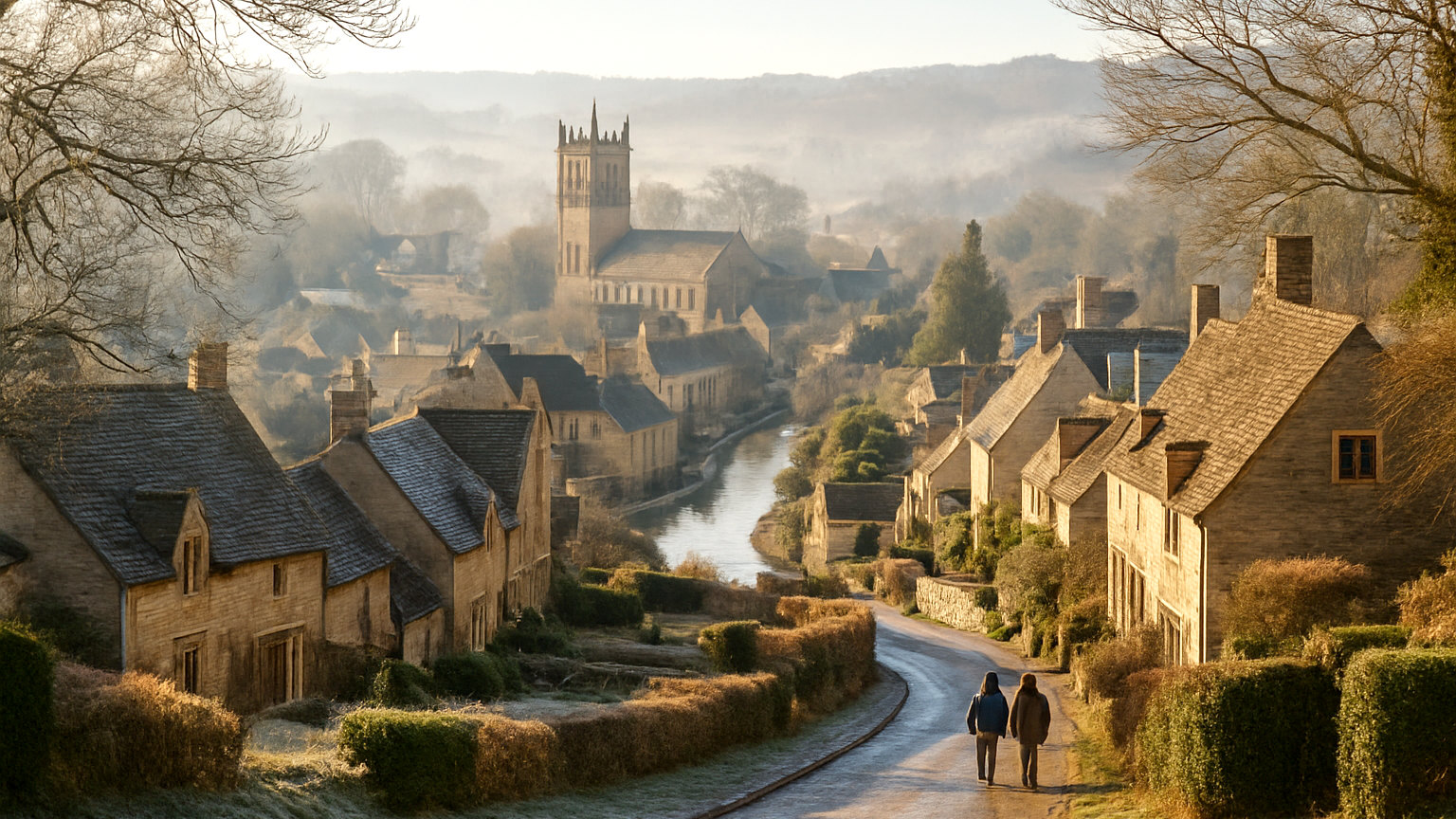
The Cotswolds are the largest protected landscape in England, a belt of oolitic limestone running from Bath to the edge of Stratford. The stone weathers to a honey colour, was easy to work and produced villages of unusual consistency, funded by the medieval wool trade.
Why do the villages look like that?
Because the same local limestone was used for everything, from cottages to churches to walls, and because the area became poor after the wool trade declined and could not afford to rebuild.
That poverty preserved it. By the time money returned, the buildings were valued and protected rather than replaced.
What are the wool churches?
Enormous parish churches built by merchants who grew rich on fleeces, far larger than their villages ever justified, at Northleach, Chipping Campden, Cirencester and Fairford.
Fairford retains a complete set of medieval stained glass, which is exceptionally rare in England and free to see.
Which villages are busiest?
Bibury, Bourton on the Water, Castle Combe and Broadway, all of which receive coach traffic and can be shoulder to shoulder by mid morning in season.
They are genuinely beautiful and they are also small residential places absorbing very large numbers, with parking limited and enforced.
Where should you go instead?
Chipping Campden, which is larger and absorbs visitors better, with a market hall and a fine high street. Winchcombe, Painswick, Northleach and Blockley.
The Coln valley, the Windrush villages away from Bourton, and almost anywhere on the western escarpment above Stroud.
What is the escarpment?
The western edge of the limestone, dropping sharply to the Severn Vale, with beech woods, common land and views across to Wales on a clear day.
Cleeve Hill, Painswick Beacon and the ground around Broadway Tower are the best of it, and this is where the walking is.
What is the Cotswold Way?
A national trail of around a hundred miles from Chipping Campden to Bath, following the escarpment for most of its length.
It is well waymarked, never remote and can be walked in sections with buses, which makes it one of the more approachable long distance paths in England.
What houses and gardens are there?
Blenheim Palace on the eastern edge, a World Heritage Site in a landscape park. Sudeley Castle at Winchcombe, and Snowshill Manor with an eccentric collection.
Hidcote and Kiftsgate, two celebrated gardens facing each other, and Chastleton, an unrestored Jacobean house.
Can you get there without a car?
Partly. Trains reach Moreton in Marsh, Kemble, Stroud and Cheltenham, and buses link some villages, though services are thin.
Walking or cycling between villages is genuinely practical, since they sit a few miles apart, and is the better way to see the area.
Where should you stay?
A village with a pub rather than a town, and preferably one not on the coach route. Chipping Campden, Winchcombe, Painswick and Northleach all work.
The area is expensive, with a substantial supply of high end accommodation and less at the budget end.
When should you go?
Spring and autumn, and midweek. The villages are quiet before ten and after five even in summer, which is when they look their best.
Winter is empty and the stone looks its warmest in low sun, though some attractions close.
What should you remember?
That people live in these villages. Photographing private cottages, blocking lanes and parking on verges are all common complaints, and several villages have introduced restrictions in response.
Park in the designated car park, walk in, and buy something while you are there.
What about the food and markets?
Several towns hold farmers markets, and the area has a strong reputation for pubs with rooms serving proper food. Stow, Cirencester and Chipping Norton all have regular markets. Prices reflect the affluence of the area, and the best value is generally at lunchtime rather than dinner.
One final point: the Cotswolds are a working farming landscape rather than a preserved one, so expect tractors on the lanes and livestock in the fields you walk through.