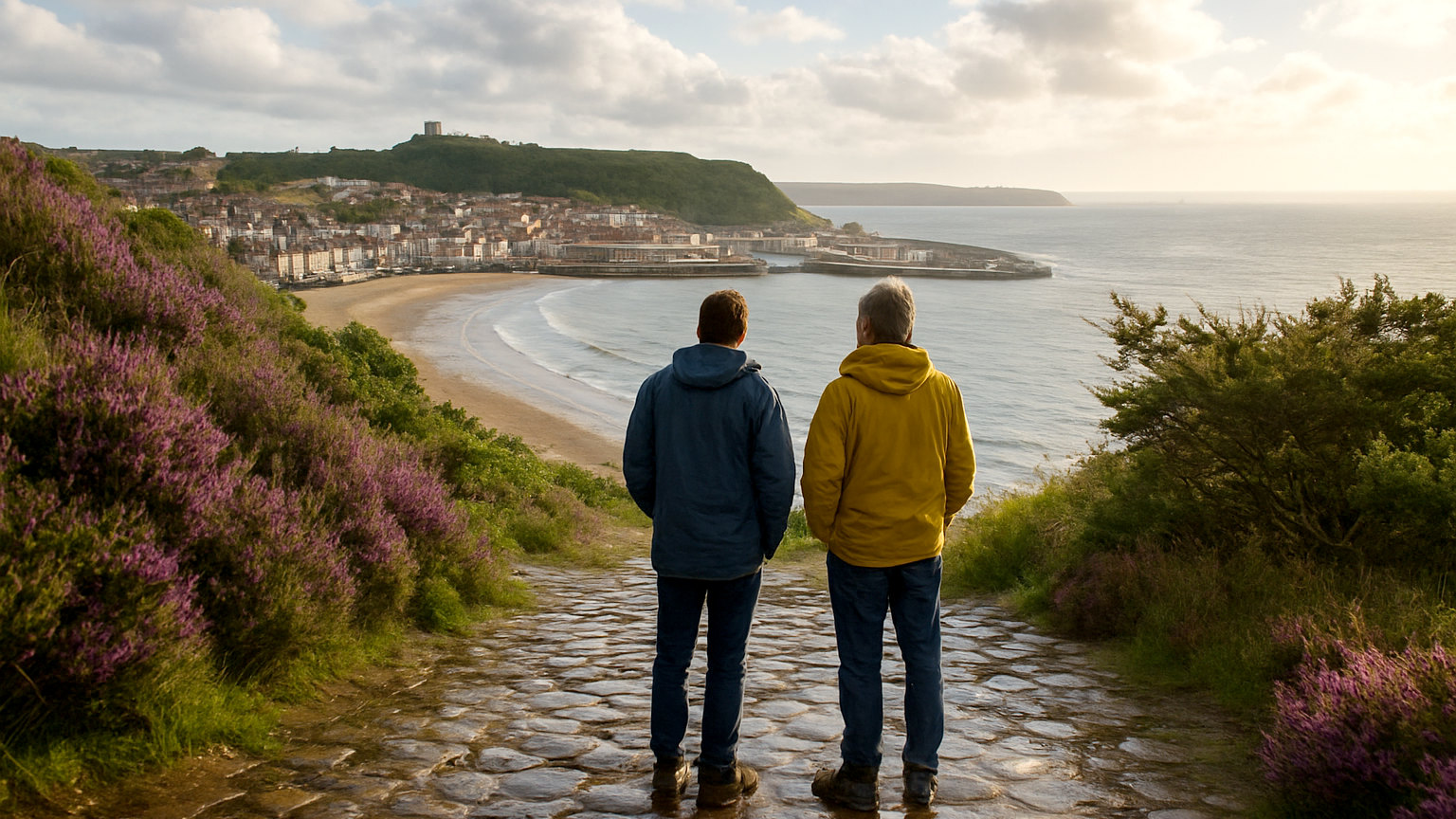
Scarborough claims to be the first seaside resort in Britain, dating from the discovery of mineral springs in the seventeenth century, long before sea bathing became fashionable. It occupies two bays either side of a headland crowned by a castle, and the two halves have quite different characters.
What is at the castle?
A substantial medieval fortress on a headland with cliffs on three sides, occupying a site used since the Iron Age and holding a Roman signal station.
The curtain wall, the keep and the enormous grassy interior are open, and the views along both bays explain the town's geography immediately.
What is the difference between the bays?
South Bay is the traditional resort, with the harbour, amusements, the spa complex and the older streets rising steeply behind.
North Bay is quieter and more residential, with a longer beach, gardens and an open air theatre, and is generally the better side for a peaceful day.
What is the spa?
A Victorian complex on the south bay with a concert hall, gardens and a promenade beneath the cliff, built around the mineral springs that started the town's fortunes.
It still hosts concerts and events, and the surrounding cliff gardens are extensive.
What are the cliff lifts?
Funicular railways connecting the seafront to the town above, of which one is claimed as the oldest still operating in Britain.
They are cheap, quick and considerably preferable to the climb.
What about the harbour?
A working fishing harbour with a lighthouse on the pier and boats landing daily, alongside pleasure craft and trip boats.
Seafood is landed and sold locally, and the harbourside is the best part of the south bay.
What is the literary connection?
Anne Brontë came here for her health and died in the town, and is buried in St Mary's churchyard beneath the castle, which is the only Brontë grave outside Haworth.
A well known playwright ran the theatre here for many years and premiered a large number of plays in the town.
What is nearby?
The North York Moors immediately inland, and the coast north to Robin Hood's Bay and Whitby and south to Filey and Flamborough.
Bempton Cliffs, half an hour south, holds one of the largest seabird colonies in England with puffins and gannets viewable from clifftop platforms in summer.
How do you get there?
By train from York in around an hour, with connections across the north, and by road across the moors or up the coast.
The station is central and the town is walkable, though steep between the seafront and the upper streets.
Who does it suit?
Families, given the beaches and amusements, and anyone wanting a traditional resort with genuine history rather than only entertainment.
Like several British seaside towns it has faced economic difficulty, which is visible in places away from the front.
How long do you need?
Two or three nights, using it as a base for the coast and the moors, which is what the town does best.
Summer is busy, and spring and autumn give the beaches and the castle with a fraction of the people.
What about the Rotunda?
A purpose built circular geology museum from 1829, designed to display rock strata in the order they occur, which makes it one of the oldest surviving purpose built museums in the country. It covers the fossils and geology of the Yorkshire coast and is small, unusual and frequently missed by visitors heading for the beach.
What about the surrounding coast?
The Cleveland Way runs along the cliffs in both directions, giving spectacular walking north to Robin Hood's Bay and south to Filey Brigg, a rocky spit running into the sea. Buses serve the coast, which makes linear cliff walks with a ride back entirely practical and considerably better than a circuit.
One last thought: Scarborough is a working town with a substantial resident population rather than a resort that closes in winter, which means it functions year round and is at its best on a bright cold day with the castle above an empty beach.